Engineering Autonomous Systems: How Human-Guided Robotics Training Powers Physical AI Data Pipelines
Autonomous systems have begun venturing outside controlled environments and into settings such as homes, manufacturing units, hospitals, and warehouses. But creating intelligent robots requires more than powerful algorithms; physical AI companies need high-quality physical AI data pipelines that enable machines to understand objects, human intent, physical interactions, and changing environments.
But as robotics advances toward becoming embodied AI, the challenge is no longer only building models, but creating scalable physical AI pipelines for data collection, annotation, and deployment of diverse multi-modal robotics data.
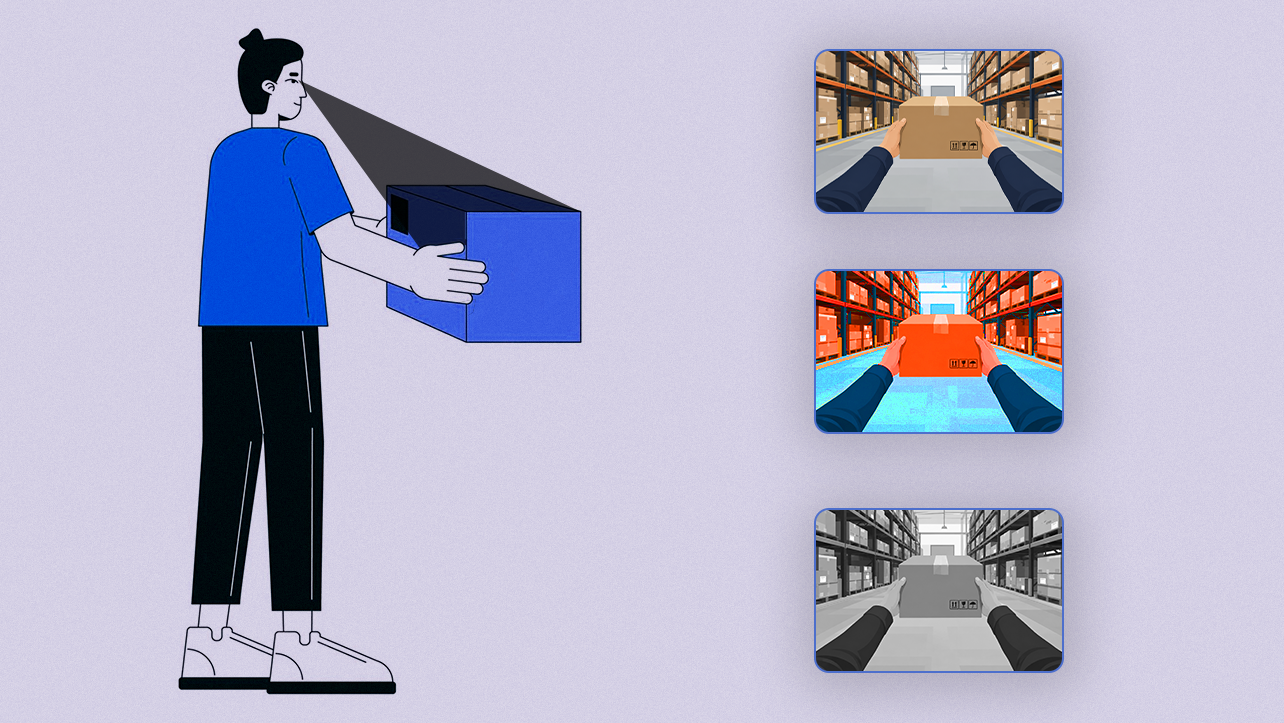
From first-person POV video and egocentric data collection to human-guided robotics training, the future of autonomous systems relies on richer real-world experiences.
In this evolving landscape, Robgence enables companies to build production-ready robotics datasets and physical AI data pipelines for scalable robot learning and autonomous intelligence.
1. Scaling Physical AI: What It Takes to Engineer Truly Autonomous Systems
Traditional AI systems are often trained on datasets representing digital tasks, while autonomous systems require continuous interaction with the physical world. But when we try to build autonomous systems, we need robots that can learn and interact with the physical world — from factory robots manipulating parts to service robots working in complex human environments.
The Autonomous System Stack
For embodied intelligence, robots need:
Multi-modal perception data: Using vision, depth, audio, IMU, sensors to perceive the environment.
World Understanding: Understanding object relationships, physics and human intent based on multi-modal robotics data.
Decision-making: Converting observations into reliable actions by training physical AI models.
Action execution and continuous learning: Enhancing abilities via real-world interaction and feedback.
Embodied AI differs from digital AI because it requires the connection between perception and physical actions. Scalable physical AI data collection and infrastructure are becoming increasingly important for building robots that can adapt to different sectors, including manufacturing, healthcare, logistics, and domestic use cases.
2. The Role of Human-Guided Robotics Training in High-Fidelity Physical AI Data Pipelines
Although simulation aids in developing robots, it fails to capture the complexity of the real world due to disparities in physics, unexpected human interactions, and limited environmental diversity.
The Importance of Human Guidance in Robot Learning
Operator-in-the-loop imitation learning uses human expertise to train robots. Human-guided robotics training combines human and machine learning techniques to:
Human demonstration: Teach robots how to perform complicated activities such as manipulation, assembly, and navigation.
Corrective signals: Help to improve robot policies through showing better actions when there is failure.
Understanding tasks: Capture human intentions, decision making, and manipulation.
Robots are able to learn from real-world experience as opposed to simulated experience using operator-in-the-loop imitation learning. High-fidelity physical AI model training through scalable physical AI data collection can be done for industries such as manufacturing, healthcare, and logistics.
3. From Human Demonstrations to Robot Intelligence: Force-Aware and Operator-in-the-Loop Imitation Learning
Robots can learn physical skills from human demonstrations captured through teleoperation, motion data, and structured action annotations. Operator-in-the-loop imitation learning is an approach that establishes a link between human demonstrations and policy training for robots.
From Demonstration to Autonomous Behavior
Human performs task: The operator controls robots through performing tasks such as assembly, picking, packing, and manipulation.
Teleoperation data collection: Robot teleoperation datasets are gathered from sensor-rich demonstrations.
Action annotation: Human actions are annotated to structure the training data.
Policy learning: Behaviors are learned via imitation learning and behavior cloning.
Autonomous execution: Robots deploy the learned skills to perform tasks autonomously.
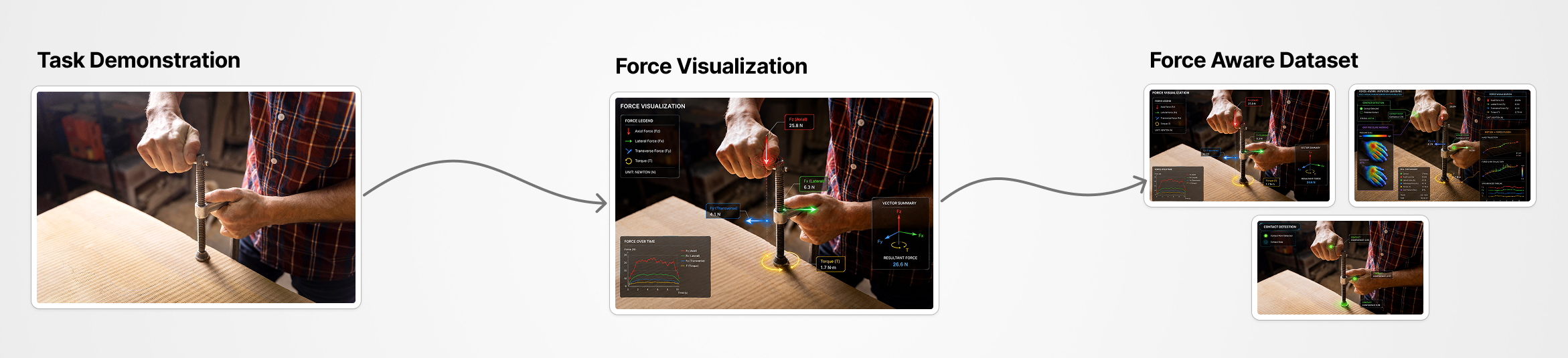
Apart from the movement, force-aware imitation learning enables robots to learn force-related information such as grip pressure, contact points, and object interaction dynamics, which are vital when working with delicate items in manufacturing, health care, and service robotics.
Robgence offers scalable teleoperation data collection and human demonstration datasets for high-quality physical AI training pipelines for advanced autonomous systems.
4. Why Multi-Modal Robotics Data Is the Foundation of Autonomous Systems
Unlike conventional AI solutions which depend on visual inputs mainly, autonomous robots require full awareness of the physical environment. Multi-modal robotics data consists of several inputs that will help machines to observe, interpret, and act properly in varying conditions.
Building Complete Robot Perception
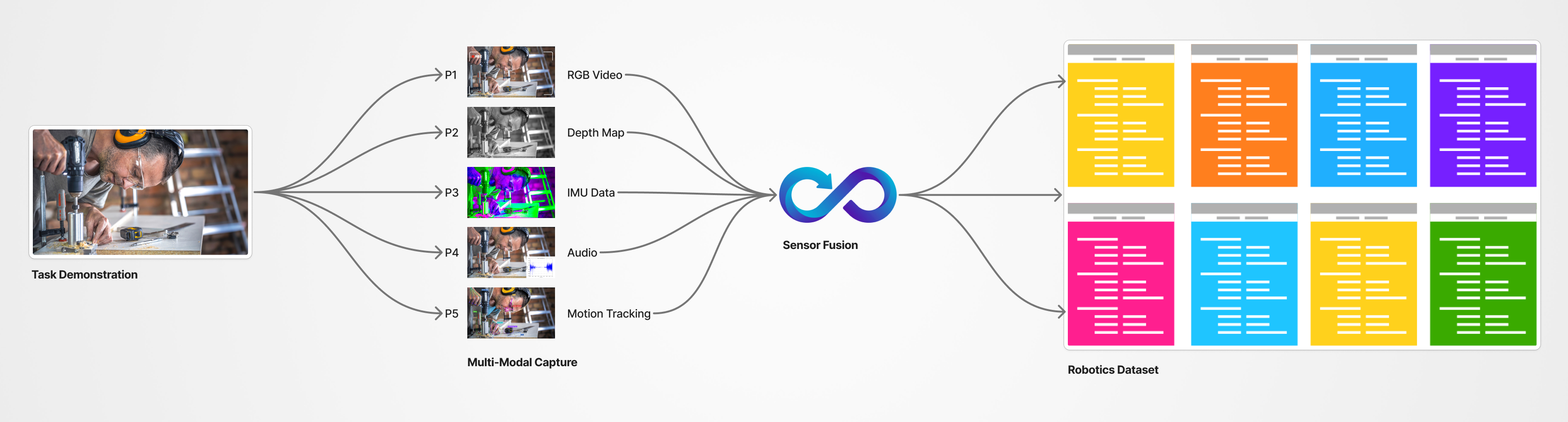
Robotics multi-modal perception data is a combination of first person POV video, egocentric data collection, human motion capture, robot trajectory tracking, and sensor data including IMU, depth, force, and audio data. With multi-modal sensor fusion, robots will be able to not only know what happens, but also the reasoning behind what happened, how the activity was done, and what would happen next.
A warehouse robot needs vision to identify objects, depth to determine position, force feedback to perform safe operations, and human motion data for manipulation. Scalable physical AI data pipelines combine these data types that allow advanced robot learning.
5. Architecting Physical AI Data Pipelines: From Multi-Modal Capture to Model Training
Creating advanced autonomous systems is not just about collecting raw data but also about building structured physical AI data pipelines which turn the real-world experience into usable datasets.
The Physical AI Data Pipeline
Physical AI Data Collection: The real-world data is collected using egocentric videos, teleoperation, human motion capture, and synthetic data generation in different environments.
Multi-Modal Capture Station: The multi-modal capture station is used to combine the RGB video, depth, IMU, audio, and motion data to build the multi-modal robotics data.
Annotation Pipeline: Advanced labeling includes VLA Action Annotation, object detection, action segmentation, human intent, and physics-aware labels.
Model Training Pipeline: The structured datasets support the VLA models, imitation learning, and embodied AI systems.
Effective scaling of embodied data requires reliable collection, annotation, and delivery infrastructure. Robgence offers you an end-to-end physical AI infrastructure with scalable data collection, annotation, and training-ready datasets for next-gen robotics.
6. Embodied Data Scaling: Why Physical AI Companies Need Infrastructure, Not Just Datasets
The training of autonomous systems is not only about collecting individual examples. It may take thousands of individual examples of the same robot task performed in various settings, objects, environmental conditions, and human behaviors to make it perform reliably.
Scaling Physical AI Beyond Data Capture
Data scaling for physical AI needs robust physical AI infrastructure capable of handling the challenges of scaling embodied data. Physical AI companies need a global network of operators, standardized process of capturing and consistent annotation frameworks to create reliable training datasets.
Unlike the standard datasets for AI, robotics datasets need to be rich with real-life nuances, including variations in manipulations and environmental conditions. Hence, it is vital to have physical AI infrastructure to create scalable embodied AI data solutions.
7. Why General-Purpose Robots Depend on Scalable Operator-in-the-Loop Imitation Learning
For general-purpose robots to be capable of completing diverse actions in an unpredictable environment, programming alone is inadequate; robots have to continuously learn from human expertise.
Scaling Robot Learning Using Human Guidance
With operator-in-the-loop imitation learning, robots learn intricate actions by mimicking the actions of experienced operators while completing actions like assembling, picking in warehouses, cooking, and healthcare support.
Large-scale teleoperation dataset collection creates diverse robot teleoperation datasets, capturing the decision-making, manipulation, and variations in tasks.
Human demonstrations at scale help train physical AI models with high-quality action data in order to train the VLA models and embodied AI.
As robotics technology continues towards general-purpose intelligence, companies will have to use reliable physical AI data pipelines for collection and validation of human-guided training data. This is made possible by Robgence through its global operator networks and teleoperation data collection of production-ready robotics data.
8. The Future of Autonomous Systems: Moving Toward General-Purpose Robots
The next wave of robotics innovation is shifting from single-purpose automation to general-purpose robots that can adapt to different industries, environments, and tasks. This is being facilitated by advancements in humanoid robots, vision-language-action models (VLA models), world models, and continuous robot learning.
Building the Foundation for General-Purpose Intelligence
Future robots will not only have bigger models but will be able to learn continuously using physical AI infrastructure that helps with learning from varied experiences in the real world. In order to develop high-fidelity embodied AI, it is necessary to have high-quality robotics data, human demonstrations, and robust physical AI data pipelines.
In a competitive landscape for autonomous systems, companies will find an edge when they develop robust data foundations to create adaptive robots. Robgence enables this future through scalable physical AI data solutions for robot learning and model training.
9. How Robgence Delivers End-to-End Infrastructure for Human-Guided Robotics Training
Autonomous systems demand robust physical AI infrastructure to convert physical experiences into trainable datasets. Robgence serves as the data engine of autonomous intelligence by providing a platform for scalable human-guided robotics training.
End-to-End Physical AI Data Solutions
Egocentric Data Collection: Robgence records first person POV videos and human demonstrations using REBOCAM in homes, factories, hospitals, and commercial facilities.
Multi-Modal Robotics Data Generation: Synchronization of video, depth, IMU, audio, and motion data provides robust datasets for physical AI model training and multi-modal sensor fusion.
Teleoperation Data Collection: Robot demonstrations and dexterous manipulation generate observation and action pairs for imitation learning algorithms.
VLA-Ready Annotation & Scaling: 6-layer annotation of 6 layers provides action labels, grasp taxonomy, object state, intent, physics-aware labels, and natural language.
Through 20,000+ human operators in 50+ cities and 5 continents, Robgence supports scalable embodied AI data solutions for future robotics.