Force-Aware Imitation Learning and Egocentric Video: Redefining Next-Gen Physical AI World Models
Large Language Models revolutionized AI by learning from large amounts of text. Physical AI, on the other hand, requires learning from real-world interactions. Current world models, Vision-Language-Action (VLA) models, and embodied AI require much more than simple images; they require egocentric videos, multi-modal robotics data, force-aware imitation learning, and synchronized sensory data to learn about human interactions with objects, environments, and physical forces.
Third-person datasets show only what happened; however, in order to build world models or autonomous robots, one needs to know much more — grasp mechanics, contact forces, intentions, object affordances, and manipulation techniques. This necessity makes physical AI data collection, teleoperation data collection, and first-person POV video collection essential parts of building physical AI model training pipelines.
With physical AI companies trying to build increasingly capable robots, access to reliable egocentric data collection, multi-modal sensor fusion, and human-guided robot training becomes a crucial competitive advantage. Robgence provides this capability in the form of a full physical AI data infrastructure pipeline providing scalable real-world datasets for next-generation world models.
1. Why Embodied AI Models Require Real-World Physical Experience
While LLMs learn from text, embodied AI and physical AI learn based on real-world interactions. Robots need to understand motion, force, physics, and causality, not patterns, in order to create reliable world models.
From Language Learning to Learning the Physical Environment
In whatever task, whether manufacturing products in factories, picking items in warehouses, helping in hospitals, or completing domestic chores, robots need to learn by experience, much like humans do. In this regard, real-world egocentric video, first-person POV Video, egocentric data collection, and multi-modal robotics data become very important in physical AI model training.
With the combination of multi-modal sensor fusion, teleoperation data collection, and human-guided robotics training, developers can capture not only the event itself, but also the process behind the event.
2. First-Person POV Video: What Is Real-World Egocentric Video?
Real-world egocentric video is first-person POV Video that is captured from the point of view of the agent performing the activity, most commonly with the use of head-mounted cameras or robot-mounted sensors. The camera records the experience as seen by the agent performing an action, capturing hand movements and object manipulation from an agent's point of view.
Seeing the World Through the Robot's Eyes
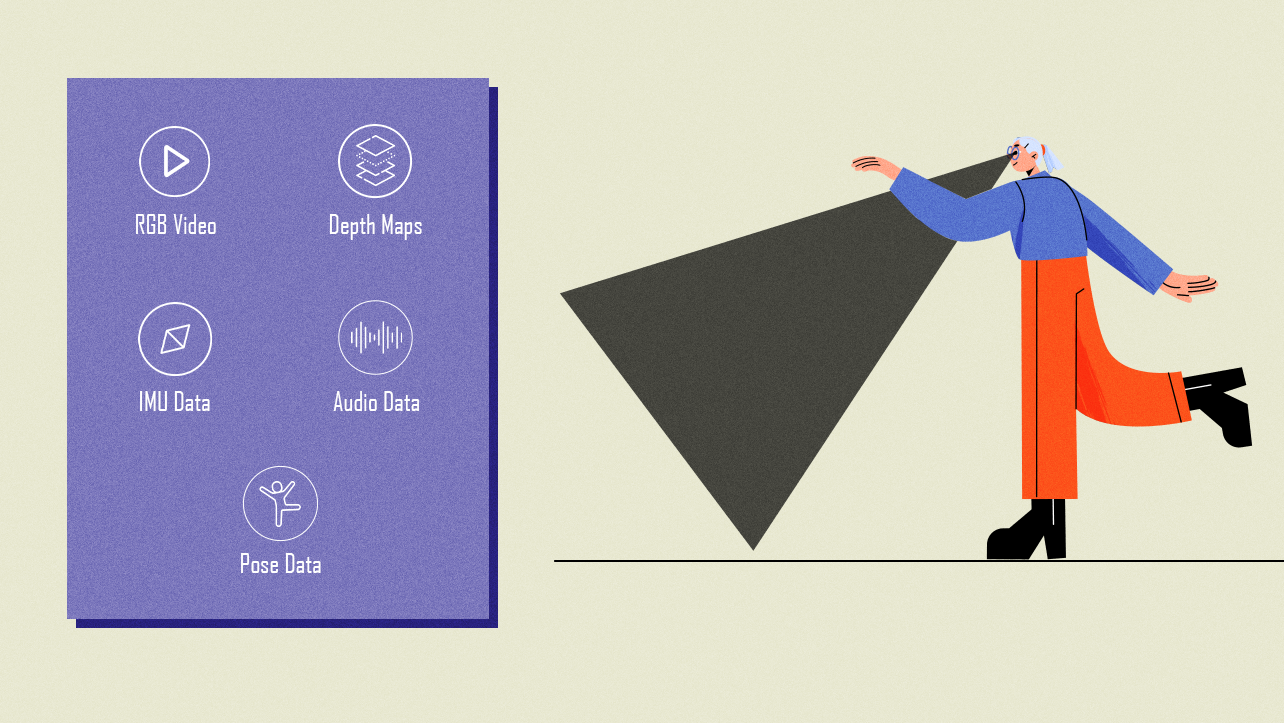
Such an approach to egocentric data collection is revolutionizing physical AI data collection in homes, warehouses, hospitals, manufacturing facilities, and retail spaces. With multi-modal perception that includes RGB video, depth maps, IMU, audio, and pose data, egocentric data collection is producing more detailed multi-modal data for physical AI model training and Vision-Language-Action (VLA) models.
At Robgence, the REBOCAM is designed specifically for efficient egocentric data collection, synchronizing multiple sensor streams into high quality multi-modal robot learning datasets.
3. The Limits of Third-Person Data: Missing Force, Intent, and Context
Traditional third-person cameras have been at the core of many developments in the field of computer vision, yet they fail to provide the data required for physical AI and embodied AI. The robot must not only know what happened but also how and why it was done in order to create accurate world models.
What Third-Person Data Doesn’t Capture
Contact & Force Cues: The amount of force/pressure used when interacting with objects.
Human Intent: The purpose of actions and decision-making process behind it.
Depth and Spatial Relations: Proper distances, object orientations, and interaction geometry.
Manipulation Strategy: Finger placement, grip adjustments, and object affordances during tasks.
Attention: Where the operator looks before and during the action.
Such cues are necessary to train physical AI models to make autonomous robots, learn force-aware imitation learning, and improve multi-modal robot learning. For physical AI data collection, interactions rather than observations are necessary, therefore true physical AI data collection requires egocentric video and multi-modal robotics data from the real world.
4. The Multi-Modal Data Engine Behind Force-Aware World Models
A single video stream may show what happens, but it won't be able to fully clarify how this interaction took place. Modern physical AI needs to use multi-modal robotics data where different streams of synchronized sensors provide understanding of every action and their environments.
The Building Blocks of Multi-Modal Robotics Data
RGB Video: Captures human actions and object interactions.
Depth Maps: Distance, object geometry, spatial relationship measurement.
IMU Data: Movement, orientation, and acceleration registration.
Audio: Provides information about collisions, tool use, and environment sounds.
Pose Data: Body, hand, joints movement tracking.
When these signals are synchronized through multi-modal sensor fusion, this gives a more informative description than just one isolated video stream. It supports force-aware imitation learning, multi-modal robot learning, and physical AI model training to learn contact, motion, and intent. It helps to build better and reliable world models and enable autonomous systems to do sophisticated actions in manufacturing, healthcare, logistics, household, and other environments with greater precision.
5. Why Force-Aware Imitation Learning Depends on Egocentric Data
In many cases, however, success in robotic tasks depends not only on the motion of a robot, but on the force it applies. A robot needs to know how much force to apply to hold a glass, how much force to apply when manipulating fruit or closing a drawer. Force-aware imitation learning and real-world egocentric video data are the keys here for training physical AI models.
What Robots Need to Learn
Grip Force: Proper grip force without dropping or damaging objects.
Slipping & Contact Detection: Detect slipping of an object and adjust grip force.
Deformation of Objects: Learn the properties of deformable and rigid objects.
Affordance Labels: Find safe spots to manipulate or grasp an object.
Physics-Aware Annotations: Track force vectors, action annotation, contact points.
Using the combination of egocentric data collection with multi-modal robotics data, developers build more complete datasets for human-guided robotics training, multi-modal robot learning and better world models which understand interaction and intent. The end-to-end physical AI data pipelines offered by Robgence help organizations train better world models, enabling force-aware imitation learning through scalable egocentric data collection, multi-modal robotics data, and physics-aware annotations.
6. From Human Teleoperation to Force-Aware Robot Policies
Training Robots Using Human Expertise
One of the most effective ways of training physical AI is through robot learning from human expertise. This method consists in human-guided robot training and teleoperation data collection, where humans perform real-world activities, with each movement, interaction, and decision being recorded to provide observation-action pairs and enabling robots to associate observations with the appropriate actions.
From Demonstrations to Intelligent Robot Policies
When these demonstrations are paired with real-world egocentric videos, multi-modal robotics data, and force-aware imitation learning, robots start learning manipulation tactics, force control, and task sequence. Operator-in-the-loop imitation learning remains crucial as human operators are capable of adapting to unforeseen circumstances, correcting errors, and demonstrating safety and efficiency which autonomous systems are still unable to manage. Robot teleoperation datasets become the basis of physical AI model training, helping world models learn not only how to complete tasks but also when and why to do that, and with how much force.
7. Scaling Force-Aware Physical AI: Overcoming the Egocentric Data Bottleneck
Why Scaling Data is the Biggest Challenge
For training sophisticated physical AI, we require much more than just collecting a few demonstrations. It is necessary for robots to have experiences in different types of environments, from actual houses and factories to hospitals, warehouses, and even retail places, in order to develop world models which will generalize beyond controlled environments. Thus, physical AI data scaling and embodied data scaling become one of the most significant problems in robotics.
Infrastructure for Large-Scale Data Collection
Egocentric data collection scaling needs efficient physical AI infrastructure, operators and multi-modal capture stations which would be able to synchronize first-person POV video, depth, IMU, audio and pose data. To solve this problem, Robgence offers an exclusive solution with REBOCAM, a purpose-built capture platform supported by a global network of trained operators, enabling robust physical AI data collection and multi-modal robotics data generation at scale.
8. The Egocentric Data Engine: Architecting Future Pipelines for Physical AI
From Data Capture to Deployment
Developing reliable physical AI starts with a well-structured physical AI data pipeline, turning real demonstrations into training-ready datasets. All stages contribute to the development of more precise world models, Vision-Language-Action (VLA) models, and intelligent autonomous robots.
Capture: Collect real-world egocentric video using egocentric data collection, teleoperation data collection, and multi-modal robotics data synchronization.
Annotation: Improve the quality of the datasets with action annotation, force-aware labels, object affordances, and temporal segmentation.
VLA Formatting: Organize data in specific formats required for training physical AI models and multi-modal robot learning.
Training & Evaluation: Train, validate, and improve robotic policies using robot teleoperation datasets.
What Robgence Does to Support This Pipeline
Robgence provides you with physical AI data pipelines, integrating REBOCAM, multi-modal capture, teleoperation, and VLA annotation to help physical AI companies train physical AI models using scalable real-world data.
9. How Robgence Accelerates Force-Aware World Models with Egocentric Data
Robgence provides an end-to-end physical AI data engine to create physical AI scalable world models: Egocentric data collection and teleoperation data collection, multi-modal robotics data, and VLA-ready datasets—all tailored to accelerate physical AI model training and embodied AI data solutions.
What Does Robgence Provide
REBOCAM for high-quality first-person POV video and scalable egocentric data collection.
Multi-modal data capture stations for synchronizing RGB video, depth, IMU, audio, and pose data.
Human-guided robotics training and robot teleoperation datasets collected via our global operator network in 50+ cities.
6-layer action annotation, force-aware labels and physics-aware metadata for force-aware imitation learning and multi-modal robot learning.
Synthetic data augmentation, motion datasets and S3 delivery for fast integration with your physical AI data pipelines.
Accelerating Robotics Research
Through the combination of real-world data capture, scalable annotation, and end-to-end data workflows, Robgence helps researchers and physical AI companies create better autonomous systems while significantly reducing the time from data collection to model deployment.