How to Choose an RLHF Data Annotation Vendor: An Evaluation and RFP Checklist
TLDR
Score vendors on four functional axes before price: throughput, inter-annotator agreement, revision turnaround, and preference-ranking consistency across raters.
Put security in the RFP body itself: SOC 2 scope, data residency, subcontractor disclosure, and deletion proof at contract end.
Benchmarks beat demos. Ask for a paid pilot scored against a gold set you hold back, the way EgoCross and TeleopBench from Xsens score models and rigs rather than claims.
Encord, Scale AI, Labellerr and Robgence each sit in different places on tooling, workforce depth and physical-world capture. Match the shape of your data.
Hybrid wins for most teams: in-house ontology and gold standards, vendor-run throughput, with a second vendor held at 10 to 20 percent of volume as insurance.
RLHF buying goes wrong in a predictable way. Teams compare hourly rates and tool screenshots, sign, then discover six weeks in that preference labels drift between rater cohorts and nobody can say by how much. The checklist below is built around the questions that surface that problem before the contract.
How do you evaluate an RLHF vendor's throughput, quality assurance, annotation consistency and revision cycles?
Measure four things: sustained weekly throughput at your task complexity, the QA mechanism that catches bad labels before delivery, inter-annotator agreement on a held-back gold set, and the clock time from rejection to corrected redelivery. Ask for each as a number tied to a comparable project, and verify it in a paid pilot.
What to request from every shortlisted vendor:
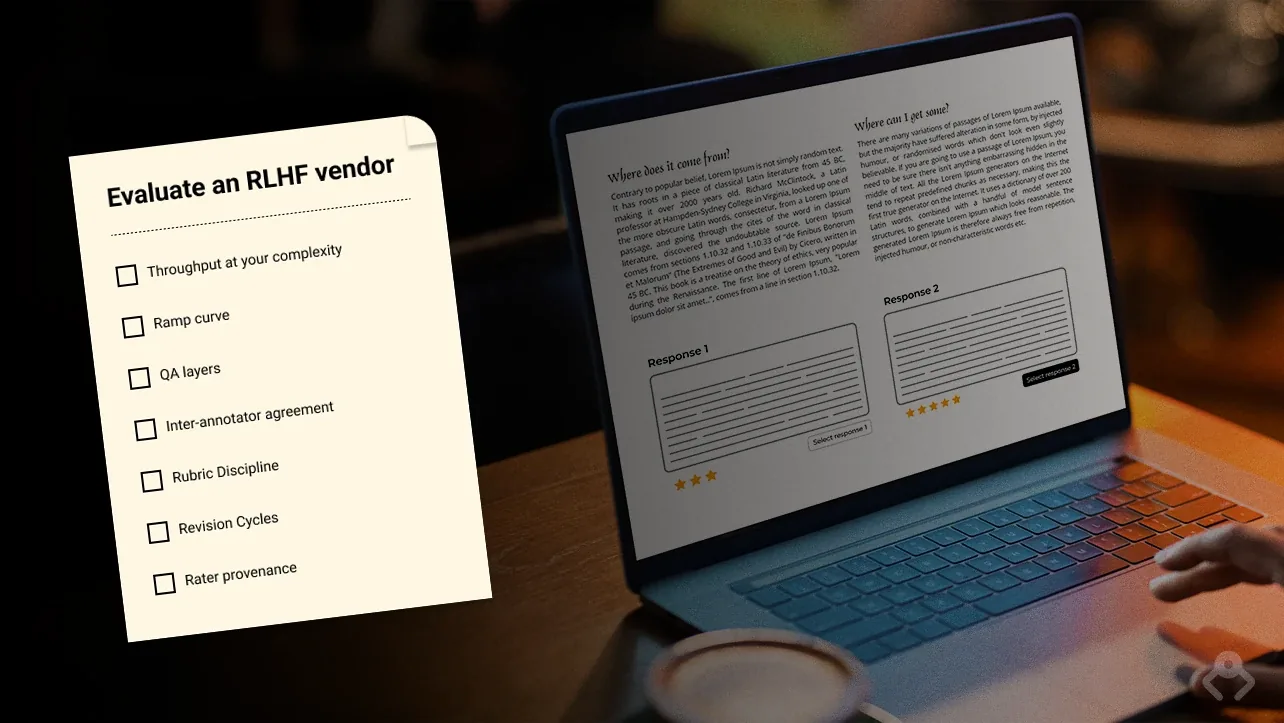
Throughput at your complexity. Items per week for a task of the same length and modality as yours. A 30-second video preference comparison and a 5-turn text ranking are different units of work.
Ramp curve. How many trained annotators are on the project in week 1, week 4, week 12, and how long a replacement takes to reach gold-set parity.
QA layers. Named layers: automated validation rules, peer review percentage, senior reviewer sampling rate, and gold-set injection frequency. "Multi-stage QA" with no sampling rate fails the question.
Inter-annotator agreement. Krippendorff's alpha or Cohen's kappa on ranking tasks, reported per cohort and over time, plus what they do when alpha drops.
Rubric discipline. Who owns the annotation guideline, how edge cases get escalated, and how long a guideline change takes to reach every active rater.
Revision cycles. Rejection rate at first delivery, turnaround on rework, and whether rework is billed. Fix the rework billing in the contract, not in email.
Rater provenance. Whether raters are employed, contracted or crowd-sourced, and whether the same cohort stays on your project across batches.
For physical AI and embodied tasks the list grows. Preference data over robot trajectories depends on capture quality upstream, so ask how the vendor handles synchronisation, calibration and failure-case coverage. Robgence's notes on building a data annotation pipeline that scales without sacrificing quality walk through the gold-set and sampling mechanics in more detail, and the Robgence data overview sets out what egocentric and teleoperation collection involves before any labelling starts.
On tooling strengths: Encord is strong on ontology management and model-assisted labelling for visual data; Scale AI brings deep RLHF workforce capacity and established preference-ranking pipelines; Labellerr focuses on workflow automation and QA dashboards; Robgence concentrates on first-party egocentric and teleoperation capture with annotation attached to the capture rig. Pick on the shape of your data.
Which non-functional requirements belong in a data labeling vendor RFP checklist?
Cost per annotation, contract flexibility, data security and SLA guarantees decide whether a technically capable vendor survives contact with your legal, finance and security teams. Put all four in the RFP body with required answers, and score them before the pilot so you don't fall in love with a vendor your CISO will reject.
Cost per annotation, stated plainly:
Unit price per accepted item, with the acceptance definition written down.
Whether rework, QA passes, guideline rewrites and project management are inside the unit price or billed separately.
Volume tiers and what happens if you miss committed volume by 30 percent in a quarter.
Price per modality: text ranking, video preference, 3D trajectory and egocentric segmentation rarely share a rate card.
Contract flexibility:
Minimum commitment and notice period. Monthly or quarterly beats annual for a first engagement.
Surge clause: how fast capacity doubles, and the premium for it.
IP and licensing: you own the labels, the guidelines and the derived gold sets, in writing.
Exit terms: export format, raw plus structured delivery, and a deletion certificate.
Data security:
SOC 2 Type II scope, ISO 27001 if claimed, and the audit date.
Data residency per jurisdiction and whether annotators work from secure facilities or personal devices.
Subcontractor disclosure, including any downstream crowd platform.
PII and face handling for egocentric footage: consent capture, blurring policy, and release documentation.
SLA guarantees that mean something:
Quality SLA expressed as minimum accuracy against a held-back gold set, with a credit if missed.
Delivery SLA per batch, with a defined late penalty.
Response SLA for guideline questions, since a 48-hour reply stalls a whole cohort.
Reporting cadence: weekly agreement scores and rejection rates, delivered without you asking.
Restated as sentences: a vendor that prices per accepted item with rework included carries the quality risk. Moving that risk is the reason the clause exists. A vendor with a surge clause and quarterly terms lets you grow or stop without a renegotiation. A vendor with named subcontractors and a deletion certificate gives your security team something to approve.
Should you build, buy or run a hybrid RLHF operation, and when should you consolidate vendors?
Build when the task is your core differentiator and judgement quality beats volume. Buy when volume dominates and the rubric is stable. Hybrid suits most teams: keep ontology, gold sets and adjudication in-house, push throughput to vendors. Consolidate when quality is proven and coordination cost is hurting; diversify while you're still learning what a good label looks like.
The decision in practice:
Build in-house if the rubric changes weekly, raters need domain expertise you can't transfer in a two-week onboarding, or the data can't leave your environment. Expect to own recruiting, tooling and attrition.
Buy outright if the unit of work is well defined, you need a step change in volume, and your internal team's time is better spent on model work. The risk sits in rubric drift.
Run hybrid if you want vendor throughput without losing rubric control. In-house staff write guidelines, maintain the gold set, adjudicate disagreements and audit batches; the vendor runs the line.
Consolidate when two vendors have converged on the same quality, your guideline is stable, and the overhead of parallel onboarding exceeds the pricing leverage you gain.
Diversify during early RLHF work, when you need a second opinion on what an ambiguous preference means, or when a single vendor represents concentration risk on a critical model release.
A practical split: give the incumbent 80 to 90 percent of volume and keep a challenger at 10 to 20 percent on the same gold set. You get live price discovery, a continuity plan, and a quality comparison that stands apart from either vendor's self-reporting.
For robotics-specific programmes, capture and annotation often belong in the same contract. Open tooling such as LeRobot on GitHub lowers the cost of standardising teleoperation formats, and Robgence's guides to top AI tools for teleoperation data collection and 25 egocentric datasets for robotics are a reasonable starting map. When you're ready to scope a pilot, the Robgence contact page is the direct route.
Frequently asked questions
How do I choose an RLHF data annotation vendor?
Shortlist three vendors, run a paid pilot of 500 to 2,000 items against a gold set you hold back, and score each on agreement, rejection rate and revision turnaround. Compare unit cost per accepted item afterwards. Pick on pilot evidence.
What are the core RLHF company evaluation criteria?
Seven criteria carry most of the decision: throughput at your task complexity, QA layering and sampling rates, inter-annotator agreement, revision cycle time, cost per accepted item, security posture including SOC 2 scope and residency, and contract flexibility with a quality SLA that has credits attached.
What should a data labeling vendor RFP checklist include?
Task definition and sample items, required throughput and ramp, QA mechanism with sampling rates, agreement reporting format, rework and rejection terms, unit pricing per modality, SOC 2 and residency answers, subcontractor disclosure, SLA with credits, IP ownership, exit and deletion terms, plus a paid pilot scope.
What are realistic RLHF service quality benchmarks?
Set them from your own gold set. Define a minimum accuracy threshold per task type, a target inter-annotator agreement, a maximum first-delivery rejection rate, and a rework turnaround in business days. Write all four into the SLA with credits for misses.
How long should an RLHF vendor pilot run?
Four to six weeks covers a full cycle: onboarding, first delivery, rejection, rework and a second delivery. Shorter pilots measure onboarding enthusiasm. Keep the gold set hidden, vary task difficulty, and include at least one mid-pilot guideline change to see how fast it propagates.
Should I use one RLHF vendor or several?
Use several while your rubric is still moving, then consolidate once quality converges. A common split keeps 80 to 90 percent of volume with the incumbent and 10 to 20 percent with a challenger on identical tasks, giving you price discovery, continuity cover and an independent quality read.
How do RLHF requirements differ for robotics and physical AI data?
Preference data over robot behaviour depends on capture quality: sensor synchronisation, calibration, egocentric viewpoint consistency and deliberate failure-case coverage. Ask vendors how they collect as well as how they label. Robgence, for example, pairs teleoperation and egocentric capture with annotation on the same pipeline.
What contract terms protect me if quality slips?
Four terms: unit pricing per accepted item, a quality SLA with service credits tied to gold-set accuracy, unbilled rework within a fixed turnaround, and a short notice period with full export and a deletion certificate. Add named subcontractor disclosure so capacity stays where you contracted it.