How to Scale Robot Teleoperation Data Collection for Physical AI?
Today, as robots venture beyond controlled laboratory settings into homes, warehouses, hospitals and factories, the biggest challenge is no longer developing smarter models but building better data. Every successful robot learns from thousands of real-world demonstrations, which makes teleoperation data collection an essential foundation for physical AI model training. For enterprises and research labs, collecting a few demonstrations is easy but scaling them into diverse, high-quality, and training-ready robot teleoperation datasets is a different challenge. Such data needs to be captured across environments, synchronized across multiple sensors, consistently annotated, and validated before it can drive reliable autonomy. This growing need has shifted the industry's focus from just collecting data to building robust physical AI data pipelines and physical AI infrastructure that support large-scale robot learning. At Robgence, we assist physical AI companies scale teleoperation data collection through globally distributed operations, multi-modal capture, and training-ready data delivery.
1. What Is Robot Teleoperation Data Collection?
Robot teleoperation is the remote control of a robot by a human operator via a joystick, VR controller, haptic interface, or some other input device. In the process of collecting data for training models, the operator’s commands are synchronized with the robot’s sensor streams to generate training datasets for downstream models.
In general, teleoperation data collection involves:
Observations: Camera frames, depth, force, proprioception, and other sensor inputs
Actions: The control commands provided by the operator
Trajectories: Time-aligned sequences of observations and actions that could serve as human demonstrations.
Robot teleoperation data collection is the process of collecting all information obtained during a session where a human operator operates a robot remotely. Every movement of the robot, its camera feed, sensor readings, and control signals are captured during the physical AI data collection, forming useful examples that AI models can learn from.
The core elements of such processes are observation-action pairs, where the observation is what the robot perceives through cameras and sensors, while the action is the command provided by the human operator in response. These examples are repeated thousands of times to provide human demonstrations for teaching robots how to perform tasks in real-world environments.
These demonstrations are then transformed into datasets that can help robots understand not only how to act, but also when to act and why to act. The more diverse the robot teleoperation dataset becomes, the more ready robots will be for autonomy.
2. Why Teleoperation Data Matters for Physical AI
Robots are not getting smarter because they are being given more precise commands; they are getting smarter because they are learning from more precise demonstrations. That's why teleoperation data collection has become a critical part of physical AI development for research labs, robotics startups, and enterprises alike.
Human Demonstrations for Robot Training
Through human-guided robotics training, skilled operators demonstrate how to perform tasks that are difficult to program with fixed rules. This could range from assembling small components, loading dishes into the dishwasher, or grabbing a fragile object carefully, allowing robots to learn from real human decisions rather than trial and error.
Teleoperation Data for Robot Training
High-quality teleoperation data enables imitation learning, where robots observe and replicate expert behavior. More advanced approaches, such as Operator-in-the-loop imitation learning and Force-aware imitation learning, go a step further by teaching robots how much force to apply, when to adjust their grip, and how to respond to unexpected situations.
This approach is especially useful in training AI to deal with edge cases—unusual situations when autonomous software systems often fail. As robotics is moving from laboratories into the real world, companies with high-quality teleoperation data capture capabilities will have an advantage in building more safer, reliable, and capable autonomous systems.
3. What Makes Robotic Teleoperation Data So Hard to Scale?
Collecting a few successful robot demonstrations is relatively simple. Scaling them into consistent, high-quality physical AI data that can train robots across thousands of scenarios is much more complicated.
Lack of Skilled Operators
Professional operators are required for collecting reliable demonstrations; however, acquiring skilled operators quickly becomes a significant challenge for robotics teams.
Hardware and Environmental Variability
Various robots, sensors, and environmental conditions require different capture environments. Collecting data across factories, homes, hospitals, and warehouses is another level of difficulty.
Data Synchronization
Modern robots work with synchronized video, sensor, and control data. Any discrepancies or inconsistencies in timing can diminish the value of robot teleoperation datasets and impact physical AI model training.
Annotation and Global Deployment
Annotation of robot-human interactions is laborious, while the distribution of teleoperation data collection across multiple locations requires standardization of operations and physical AI infrastructure.
This is where Robgence generates value by implementing a global network of operators, standardizing physical AI data pipelines, and providing strict quality assurance to help companies overcome the major obstacles in physical AI data scaling.
4. The Multi-Modal Data Bottleneck in Scaling Robotic Teleoperation
A robot does not learn from vision alone; it learns through its understanding of everything going on around it at once. As enterprises scale teleoperation data collection, the challenge of collecting multi-modal robotics data becomes one of the key blockers in building reliable physical AI systems.
Multi-Modal Teleoperation Data Streams for Robotics
Every teleoperation recording creates multiple synchronized data streams that include:
Visual data: RGB and first-person POV/camera view
Force data: Grip pressure and interaction forces
Audio: Environmental sounds and operator instructions
IMU data: Motion and orientation measurements
Depth: Spatial data and object distance
Robot states: Joint positions, velocities, and actuator status
Action trajectories: Time-aligned control commands and movements
The Challenge of Multi-Modal Sensor Fusion
All these data streams have their own value, but they are most valuable when synchronized through multi-modal sensor fusion. Misalignment of the force signal and camera frames can create discrepancies between perception and action, thus decreasing dataset quality.
In the process of developing multi-modal robot learning technology, the challenge of managing multi-modal perception data at scale increasingly grows. Creating synchronized multi-modal robotics data becomes critical for training reliable physical AI systems.
5. How to Build a Scalable Teleoperation Data Pipeline for AI Robotics
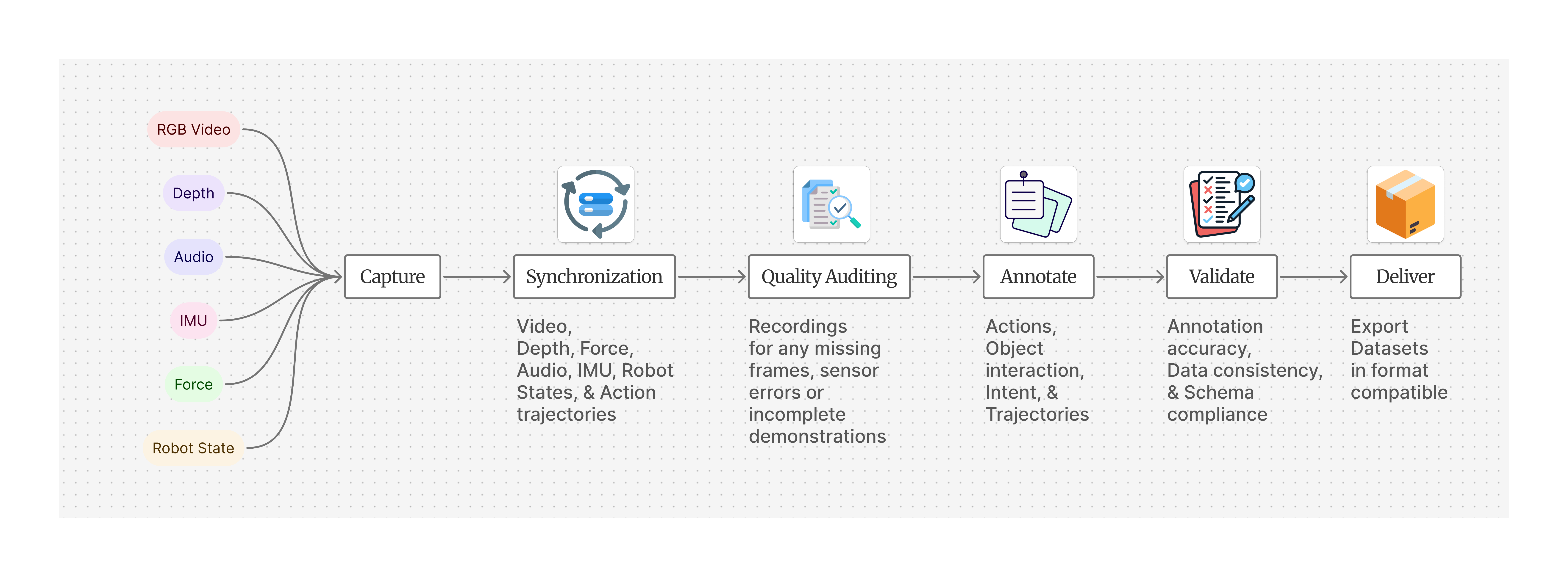
Scalability in teleoperation data collection goes beyond just collecting more data; it’s about establishing a reliable and repeatable physical AI data pipeline to generate high-quality and ready-to-train datasets. Each step in the pipeline plays a critical role in the generation of a successful model.
Capture: Gather high-quality demonstrations from various environments by using standardised teleoperation setups and multi-modal capture stations.
Synchronization: Synchronize video, depth, force, audio, IMU, robot states, and action trajectories in one time-synchronized dataset.
Quality Assurance: Continuously monitor recordings for any missing frames, sensor errors or incomplete demonstrations before being sent into the training pipeline.
Annotation: Annotate actions, object interaction, intent, and trajectories to generate structured data for physical AI model training.
Validation: Validate annotation accuracy, data consistency, and schema compliance to have reliable physical AI data collection.
Delivery: Export datasets in formats compatible with enterprise AI workflows and robotics research workflows.
Robgence simplifies this entire process through scalable physical AI infrastructure, combining global teleoperation workflows, QA automation, expert annotation, and seamless dataset delivery, allowing robotics companies to develop AI-driven autonomous robots without the hassle of data operations management.
6. Scaling Human-Guided Robotics Training
Successful implementation of human-guided robotics training depends not only on the collection of demonstrations but also on ensuring that all demonstrations contain valuable information for the robot to learn from. It is a core idea behind Operator-in-the-loop Imitation Learning, where expert operators continuously guide and fine-tune robot behavior.
A typical scalable training process involves:
Expert Demonstrations: Skilled operators perform tasks in real-life settings to create high-quality examples.
Retry Filtering: Automatically detecting and discarding unsuccessful or inconsistent demonstrations so only successful examples can be used.
Trajectory Scoring: Evaluating each action sequence for its consistency, reliability, and overall success to prioritize the best training data.
Continuous Improvement: As more demonstrations are collected, models are retrained on increasingly diverse scenarios, improving robustness over time.
Robgence supports this process through its teleoperation network worldwide, standardised data collection workflows and strict quality control measures, helping enterprises speed up Operator-in-the-loop imitation learning.
7. Teleoperation Action Annotation for Vision-Language-Action Model Training
High-quality teleoperation data collection would be useless if robots could not understand what occurred, why, and how. This is what makes VLA Action Annotation essential for transforming the initial demonstrations into high-quality training data for Vision-Language-Action (VLA) models.
An advanced annotation pipeline includes:
Frame-level action labels identify each movement and manipulation.
Intent labels describing the intent of performing an action.
Task phase annotation to split complex tasks into logical steps.
Natural language instructions that connect human commands with robot actions.
Force-aware labels teaching proper grip force and interactions with objects.
Grasp taxonomy which categorizes grasps necessary for dexterous manipulation.
Together, all these elements help to train sophisticated physical AI models by supporting multi-modal robot learning by combining vision, language, and action. At Robgence, VLA Action Annotation becomes part of the scalable physical AI data pipeline, helping to create enterprise-ready robot teleoperation datasets.
8. How Robgence Scales Teleoperation Data Globally
Scaling Teleoperation Data Collection requires not only operators but also the correct infrastructure and standardized processes. As a physical AI company, Robgence ensures all three by bringing a network of over 20,000+ trained operators located in 50+ cities and spanning 5 continents, combined with scalable teleoperation collection infrastructure to offer enterprise-grade robot teleoperation datasets.
Robgence's platform encompasses multi-modal capture stations, multi-modal sensor fusion, VLA-ready action annotation, force-aware data labeling, and QA validation processes within custom physical AI data pipelines. Every dataset is synchronized, quality-checked, and delivered S3-ready to enable smooth physical AI model training.
Looking to create robust teleoperation datasets for your robots or autonomous AI systems? Robgence can help you collect, annotate, and scale the mission-critical training data that your models require.
9. The Future of Teleoperation Data Collection
The future of robotics will be about robotic systems not just responding to instructions, but understanding them, learning from them and working together. This includes everything from humanoid robots and physical AI foundation models to shared autonomy and Human-AI collaboration. The next wave of robots will require diverse and comprehensive datasets beyond anything seen before. With Sim2Real pipelines, world models and embodied data scaling technologies advancing, enterprises will require scalable and high-quality physical AI data to stay ahead of the innovation curve.
The discussion is no longer about whether teleoperation data will define the future of robotics but who will scale this data effectively. We at Robgence are working on physical AI infrastructure, physical AI data pipelines and global data operations that help robotics companies accelerate model development today while preparing for the autonomous systems of tomorrow.