Scaling Physical AI: Multi-Modal Sensor Fusion As The Definitive Alternative To Synthetic Data
The race to build smart robots has moved from developing algorithms to sourcing high-quality physical AI data. With the progress made by the development of embodied AI and Vision-Language-Action (VLA) models transitioning from simulation to physical world applications, synthetic data alone is no longer sufficient for training robust physical AI models, as it lacks real-world physics, forces, human interactions, and edge case scenarios needed for autonomous agents.
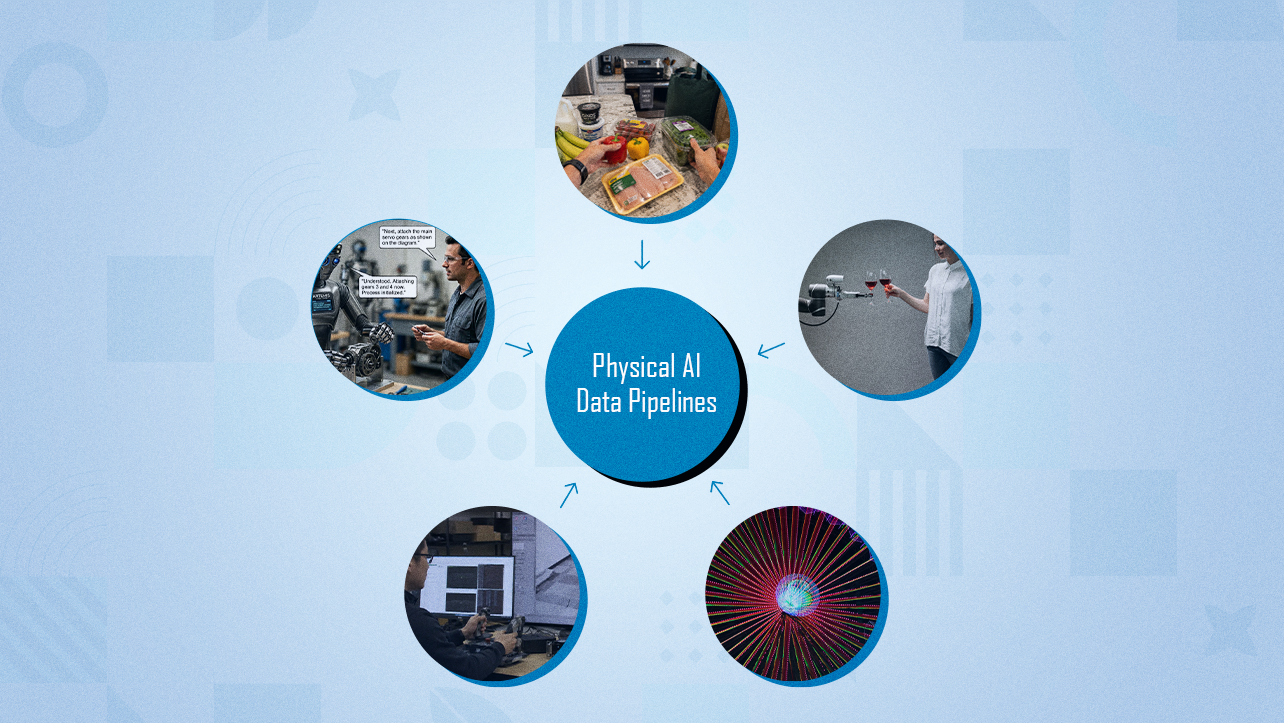
Top physical AI companies have started utilizing multi-modal robotics data, including first-person POV video, egocentric data collection, teleoperation data collection, multi-modal sensor fusion, and VLA action annotation to develop scalable physical AI data pipelines for multi-modal robot learning.
This article will examine the reasons why hybrid approaches are becoming an industry standard and how Robgence can help scale up physical AI data via multi-modal data capture stations, teleoperation data sets and ready-to-deploy physical AI infrastructure for embodied AI.
1. Why Early Physical AI Model Training Utilized Synthetic Data
Early physical AI and embodied AI development was heavily dependent on the use of synthetic data as it provided scalability and efficiency in speeding up the process of training physical AI models. Instead of recording hundreds of thousands of real robot interactions, the researchers and robotics teams were able to simulate multiple scenarios and train models in a much more efficient manner.
Such platforms as NVIDIA Isaac Sim, digital twins, and Domain Randomization were foundational for training robots to accomplish various tasks such as navigating warehouses, robotic manipulation, and autonomous inspection. Through changing lighting conditions, texture and objects' position, researchers were able to create large-scale datasets for multi-modal robot learning suitable for early development of autonomous systems.
Although this approach enabled creating initial physical AI data pipelines, it raised the demand for multi-modal robot data in the evolving models. At Robgence, we supplement the use of simulation with first person POV video, egocentric data collection, teleoperation data collection, VLA action annotation, and multi-modal sensor fusion.
2. The Limitations of Synthetic Data in Embodied AI
Synthetic data has been critical in developing physical AI, but as robots start moving from simulation into real-life environments, their limitations come into view.
Key Challenges
Inaccurate physics simulation: It can be challenging for a simulator to recreate real-life friction, object deformation, lighting changes, and contact dynamics.
Challenges with simulating humans: Real-life movements, random behavior, and interactions between humans and robots are not easy to simulate using synthetic environments.
Force interaction: Some operations require a robot to perform a task such as handling fragile objects or applying different amounts of pressure. This operation requires force-aware imitation learning, where high-fidelity real-world demonstrations often provide more reliable supervision than simulation alone.
Edge cases are hard to create: Rare occurrences, cluttered spaces, and unexpected objects are hard to generate through synthetic environments.
Sim2Real problem: Simulated models tend to perform poorly when deployed in real-world autonomous systems.
Leading physical AI companies are addressing the gap by investing in multi-modal robotics data, egocentric data collection, teleoperation data collection, and multi-modal sensor fusion.
3. Real-World Data vs. Synthetic Data for Robotics
Now that physical AI technologies are moving from laboratories to homes, warehouses, hospitals, and manufacturing facilities, there is a greater need for data collected from real-world scenarios rather than synthetic settings. Despite being helpful in building models quickly, physical AI data collection enables contextual understanding necessary for reliable operation.
Why Real-World Data Collection Matters
Human demonstrations allow capturing natural execution of the tasks, intent, and decisions.
Teleoperation data collection enables tracking accurate observation-action pairs for human-guided robotics training and operator-in-the-loop imitation learning.
First-person POV video and egocentric data collection help to recreate a robot's point of view and improve multi-modal robot learning.
Multi-modal sensor fusion involves using data from RGB video, depth perception, IMU, audio recordings, force feedback, and VLA action annotation for generation of multi-modal robotics data.
Thus, with such approaches, one can achieve more thorough physical AI model training and minimize the Sim2Real gap. Instead of substituting synthetic data, the use of embodied AI data solutions will help to build scalable physical AI data pipelines for future robotics.
4. How Multi-Modal Sensor Fusion Solves the Synthetic Data Problem
Using a single camera to train robots provides an incomplete perspective of the physical world. Modern physical AI applications must utilize multi-modal sensor fusion to successfully perceive, reason, and act across environments.
Multi-Modal Sensor Fusion for Robot Training
Today, multi-modal robotics datasets include many synchronized data streams, such as:
RGB cameras for visual information
Depth sensors for spatial understanding
IMU data for motion and orientation
Audio for context awareness
Robot pose and state data
Force and torque data for contact-aware manipulation
Action labels and natural language for VLA action annotation
This combination of inputs results in more sophisticated multi-modal perception data which enables better multi-modal robot learning for warehouses, household applications, industrial manipulation, and healthcare robotics. As opposed to individual sensor streams, synchronized modalities provide necessary context which is essential for improving physical AI model training and avoiding deployment failures.
At Robgence, we use multi-modal capture stations, egocentric data collection, and teleoperation data collection to develop production-grade physical AI data pipelines by combining synchronized sensor data for embodied AI data solutions.
5. Why Teleoperation Data is Essential for Embodied AI
With increasingly sophisticated manipulation tasks being performed by robots, there is a need for not just observations, but also the understanding of how humans interact with their environment. Teleoperation data collection allows trained operators to operate robots remotely in order to collect high-quality demonstration data for training Physical AI models.
Teleoperation Datasets for Robot Training and Embodied AI
Robot teleoperation datasets are composed of paired observation-action datasets, where every visual input is synchronised with actions performed by the operator. In conjunction with VLA Action Annotation, it helps robots learn not just how to perceive their environment but also how to respond. This forms the foundation of Operator-in-the-loop imitation learning and teaching robots dexterous manipulation tasks such as pick and place, assembly, sorting, packaging and even home assistance.
For top Physical AI companies, teleoperation data complements multi-modal robotics data, egocentric data collection and multi-modal sensor fusion in creating physical AI data pipelines and human-guided robotics training. Robgence provides scalable teleoperation data collection services, distributed operators and robot teleoperation datasets for scalable embodied AI development.
6. How Do Physical AI Companies Scale Beyond Synthetic Data?
As physical AI technologies mature, scaling training data is not only about larger synthetic environments but also involves a combination of real-world data collection and its augmentation through simulations. Industry leaders have already begun adopting this approach to create efficient physical AI data pipelines.
The Modern Physical AI Data Pipeline
A typical workflow consists of:
Real-world environments
Human demonstrations
Teleoperation
Annotation
Synthetic augmentation
Model Training
Real-world deployment
This hybrid approach allows for embodied data scaling through collecting various human-machine interactions and scaling them via simulation. This way, robots can learn on authentic first-person POV video, egocentric data collection, multi-modal robotics data, and teleoperation data collection, where synthetic data helps diversify the dataset. This results in scalable Physical AI data scaling in warehouses, factories, hospitals, and homes.
At Robgence, we offer end-to-end physical AI infrastructure, including multi-modal capture stations, VLA action annotation, robot teleoperation datasets, and embodied AI data solutions.
7. Multi-Modal Sensor Fusion with Synthetic Data: Bridging the Sim-to-Real Gap
It’s no longer a matter of synthetic data or real-world data. Instead, leading physical AI companies have shifted their focus on how much real-world data should be leveraged to make synthetic data truly effective.
A Hybrid Strategy for Physical AI Training
The combination of multi-modal sensor fusion of multi-modal robotics data, first-person POV video, egocentric data collection, teleoperation data collection, and VLA action annotation, alongside synthetic data, narrows the Sim2Real problem gap by creating a blend of real-life demonstrations and synthetic augmentations.
This strategy improves physical AI model training, facilitates continuous learning, and builds scalable physical AI data pipelines for multi-modal robot learning. From warehouse automation to service robotics, hybrid datasets help robots generalize beyond controlled simulations.
8. The Future of Physical AI: Why Hybrid Data Pipelines Will Win
In the future, the competitive edge for physical AI foundation models will hinge more on pipeline scale than model architectures themselves. Those who can continuously integrate physical interactions and simulations in order to optimize their robot’s performance will gain a competitive advantage.
The New Era of Physical AI
Embodied AI data scaling now begins with real-world environments, human demonstrations, teleoperation, and multi-modal robotics data, followed by annotation, synthetic augmentation, and modeling. Such a workflow enables continuous learning, robot training assisted by humans, and safe deployment of the technology in logistics, manufacturing, healthcare, and service robotics.
With the increasing need for multi-modal perception data, those who invest in physical AI infrastructure and multi-modal capture stations will have an upper hand at creating flexible and reliable robots. We help our clients make this happen at Robgence through ready-to-deploy embodied AI data pipelines, including teleoperation data collection, egocentric data collection, VLA action annotation, and multi-modal sensor fusion for physical AI model training.
9. How Robgence Accelerates Multi-Modal Data Scaling for Physical AI
Training reliable physical AI models involves not only massive volumes of data but also scalable infrastructure that can record real-life interactions within various settings.
Scaling Physical AI Data with Robgence
Robgence offers an integrated solution for collecting and annotating physical AI data:
Multi-modal capture stations for capturing real-life interactions
Egocentric data collection and first-person POV video data collection for robotics training
Teleoperation collection for robot control data
Multi-modal annotation for structuring and labeling complex data sets
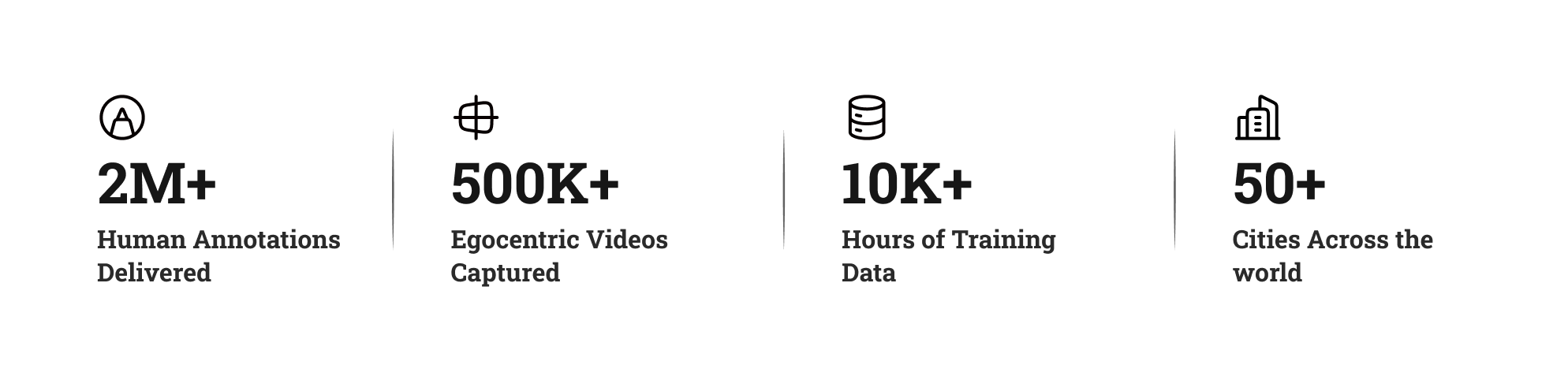
With our network of over 20,000+ operators working in over 50+ cities, we collect robot teleoperation datasets, VLA action annotation data, and force-aware imitation learning datasets that can be used for human-guided robotics training and physical AI model training.
We offer embodied AI data collection solutions in such locations as warehouses, factories, hospitals, and homes. We provide scalable, multi-modal sensor fusion along with real-world demonstrations, which results in structured S3-ready data sets suitable for your training pipeline. Whether scaling embodied AI research or commercial robotics, Robgence helps organizations accelerate physical AI data scaling from collection to deployment.