Sourcing Expert Human Labels for Physical AI: The Ultimate Guide to Operator-in-the-Loop Imitation Learning
The future generation of physical AI and embodied AI systems relies on much more than just state-of-the-art AI models and computing power. In the case of Vision-Language-Action (VLA) models, as well as autonomous systems, robots learn best from human-guided robotics training, where human expert demonstrations are coupled with comprehensive multi-modal robotics data. Contrary to other types of AI data, physical AI data collection involves not only synchronized video and depth, but IMU and force signals, and accurate VLA action annotation. With the increasing number of large-scale teleoperation projects, Operator-in-the-Loop imitation learning and multi-modal perception data collection, the main challenge of physical AI model training and data scaling is the need for highly skilled human operators.
In this guide, we will discuss why expert human labels are critical, how expert human labels differ from generic annotations, and what is the current state of physical AI data pipelines and robot learning. In addition, we will demonstrate how Robgence helps organizations create scalable multi-modal robotics datasets with the help of expert operators, teleoperation infrastructure, and end-to-end data collection workflows.
1. How to Source Expert Human Labels for Physical AI at Scale
The True Bottleneck Is Not Data But Expertise
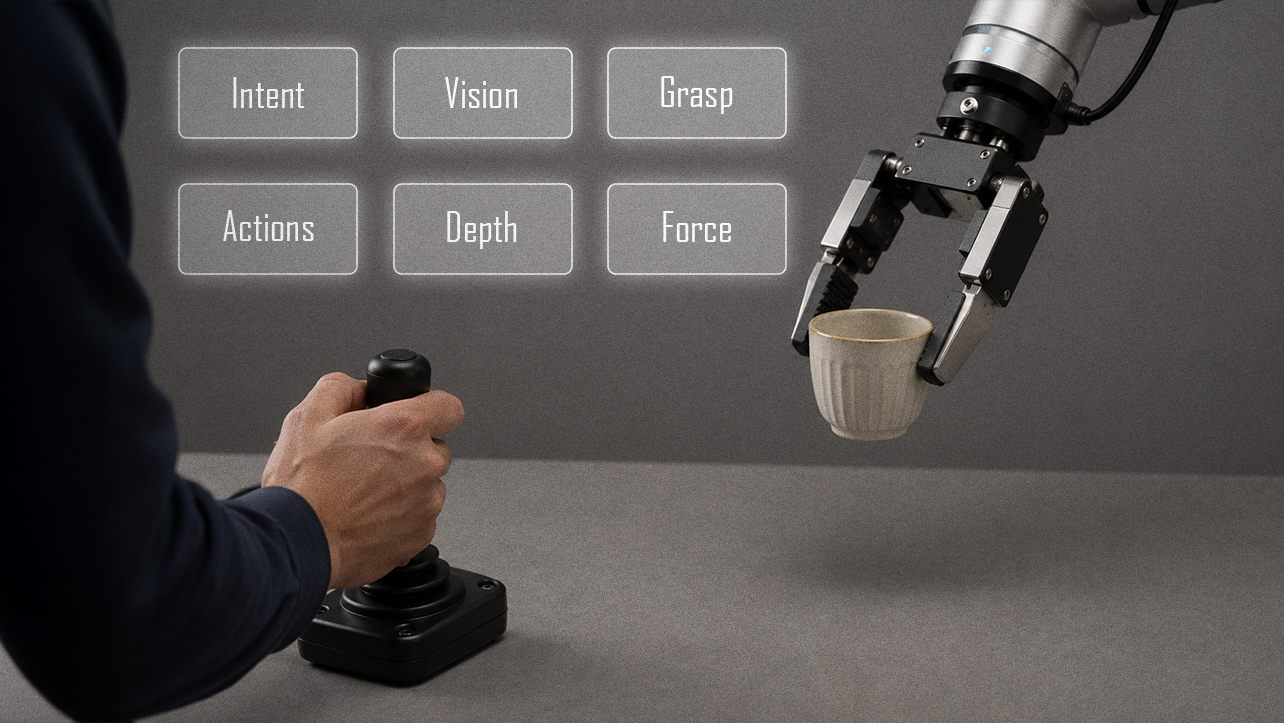
Much of the industry's focus is on scaling physical AI data and robot teleoperation datasets. However, no one asks the more difficult question of "Who creates the labels that teach robots?" Physical AI model training goes well beyond simple image annotation. It needs expert operators capable of understanding:
Manipulation and grasp strategies
Force-aware interactions
Human intent and task sequences
Robot actions and temporal reasoning
Multi-modal sensor fusion through video, depth, IMU and audio
Why Expertise Matters
Whether you're training warehouse robots to pick-and-place objects, household assistants for cooking, or healthcare robots for patient support, human-guided robotics training depends on high-quality multi-modal robotics data, VLA action annotation, and Operator-in-the-Loop imitation learning. All of these abilities are crucial for engineering autonomous systems that can perform complex tasks at scale.
Robgence solves this problem through expert operators, teleoperation data collection, egocentric data collection and physical AI data pipelines that accelerate embodied data scaling.
2. Expert Labels vs. Generic Annotation: Why Physical AI Needs Expert Operators
Traditional Annotation Fails Where Physical AI Begins
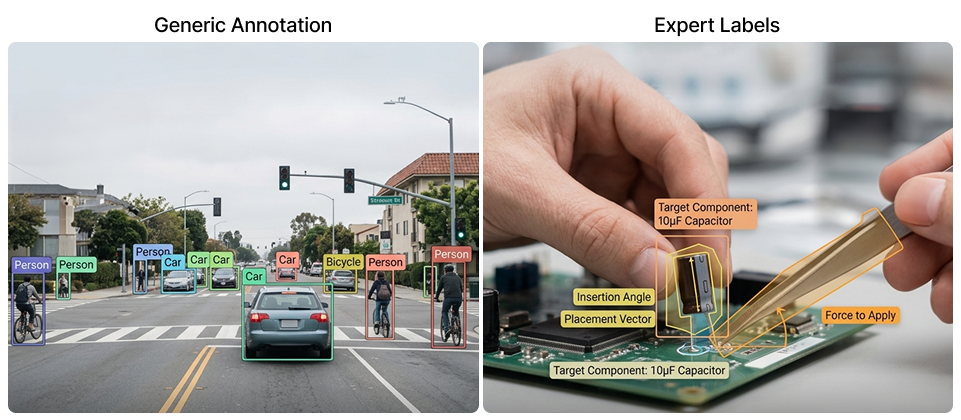
Traditional AI annotations are used in scenarios where objects are identified in images such as object detection and image classification tasks. In contrast, physical AI and embodied AI require a lot more than that because they require knowledge about how, when, and why the action is being done.
What Makes Robotics Annotation Unique?
Expert operators annotate physical AI data through actions such as:
Action labels and temporal action sequences
Force-aware imitation learning signals
Hand-object contact states and grasp types
Human intent and task phases
Multi-modal sensor data synchronized across video, depth, IMU, audio, and pose for multi-modal robot learning
For instance, the warehouse robot requires training in lifting the package carefully without crushing it while the household robot needs to understand the sequence of opening a cabinet and then picking up a cup. This kind of human-guided robot training powers Vision-Language-Action (VLA) model training capable of interaction with the physical world.
Robgence provides this kind of annotation with expert operators, multi-modal robotics data, and scalable annotation workflows built exclusively for training next-generation physical AI models.
3. What Makes a Robotics Label "Expert"? Force, Timing, and Multi-Modal Sync
Moving Beyond Labels: Understanding Human Intelligence
An expert-level robotics label provides context on how, when, and why an action was performed. In contrast to other conventional AI datasets, multi-modal robotics data integrates action segmentation, VLA action annotation, grasp taxonomy, contact points, object affordance, force estimation, intent labels, and task phases in order to form a comprehensive understanding of human behavior.
From Observation to Robot Learning
For instance, let us consider a case of a service robot that prepares a meal for a customer. The robot needs to understand when it should release its grip on the tomato, how much pressure to exert when slicing, and what the intended outcome of each action is. Such detailed labels are useful for force-aware imitation learning, multi-modal robotics learning, and generalization of the Vision-Language-Action models. All these labels together constitute the core of high-quality physical AI datasets for reliable physical AI model training.
4. Why Crowd-Sourced Labeling Fails for Operator-in-the-Loop Imitation Learning
Robotics Needs More than Generic Annotation
Annotation through crowdsourcing serves well for object detection or image classification, yet Operator-In-The-Loop imitation learning requires a lot more expertise. Understanding physical interactions cannot be derived from visual data alone.
Why Do We Need Expert Operators?
While a generic annotator can understand the act of a person picking up a mug, they will not be able to detect any other information such as grasp transitions, contact states, forces applied, robot trajectories, and temporal reasoning. Whether in manufacturing, healthcare, or warehouse automation, all of these details are directly affecting the physical AI model training, multi-modal learning, and force-aware imitation learning. High-quality physical AI data requires trained operators who are able to understand video, depth, IMU, and action data synchronization to produce accurate VLA action annotation.
5. Operator-in-the-Loop Imitation Learning: From Passive Annotation to Active Robot Learning
Modern Operator-in-the-Loop imitation learning turns humans from passive annotators into active teachers. Rather than only annotating completed tasks, experts continually instruct robots on how to learn based on real-world robotics demonstrations.
Tasks are completed by experts through teleoperation collection and demonstration.
Robots learn manipulation, force control, and task execution through such demonstrations.
Experts then validate the trajectory, action, and results.
Incorrect behaviors are relabeled and corrected.
Demonstrations are refined to make learning better through iterative processes.
Building Better Physical AI Models
This continuous feedback loop allows for more efficient human-guided robotics training, resulting in improved physical AI data, multi-modal robotics data, and accurate VLA action annotation for embodied AI and Vision-Language-Action (VLA) models. This method allows robots to adapt to challenging environments ranging from warehouses to households and industries.
Robgence offers this solution through scalable teleoperation data collection, expert operator networks, and physical AI data pipelines for next-gen physical AI model training.
6. How to Build Multi-Modal Robotics Labels: Engineering Sensor Fusion for VLA Models
No single sensor or camera can capture all that a robot must learn. Modern Vision-Language-Action (VLA) models use multi-modal sensor fusion for not just understanding what occurs, but how it occurs and why it succeeds.
Videos contain information about the visual context and the performance of tasks.
Depth, IMU, audio, pose, force, and robot states capture physical interaction signals.
Action labels, natural language, and temporal labels describe intent, sequence, and outcomes.
Why Synchronized Multi-Modal Data Matters
With every modality being synchronized through multi-modal capture stations, models get accurate multi-modal perception data needed for better manipulation, navigation, and force-aware imitation learning. For instance, a household robot performing the act of pouring water needs to synchronize vision, grip forces, motion, and timing.
Robgence provides synchronized multi-modal robotics data, egocentric data collection, and physical AI data pipelines to accelerate reliable physical AI model training.
7. How to Scale Expert Human Labels Across Diverse Real-World Environments
The challenge is not only collecting more physical AI data, but collecting the right physical AI data from diverse real-world environments. Some of the biggest challenges faced are recruiting qualified operators, maintaining high-quality annotations, conducting thorough QA, and maintaining data provenance as datasets become larger.
Recruitment of experienced operators with domain expertise
Capturing data from homes, hospitals, warehouses, and factories
Maintaining consistency in quality through QA processes
Ensuring traceable data provenance for compliant physical AI data pipelines
Scaling Physical AI
Scaling embodied data requires a global operator network and physical AI infrastructure capable of handling many different kinds of training scenarios. It allows the scaling of physical AI data to reflect the complexities of the real world instead of laboratory setups.
Robgence tackles this challenge through its global operator network, teleoperation data collection, egocentric data collection, multi-modal data collection, and enterprise-grade QA process.
8. The Future of Physical AI: Why Expert Human Data Matters as Much as Compute
From Bigger Models to Better Data
The future of physical AI will not be driven by compute but by the quality of the physical AI data with which the robots are trained. As Vision-Language-Action (VLA) models, embodied AI, and autonomous systems continue to evolve, the primary bottleneck becomes the expert human knowledge captured via real-world demonstrations. Robust multi-modal robotics data, operator-in-the-loop imitation learning, and human-guided robotics training make it possible for robots to learn about force, intent, timing, and physical interaction that compute alone cannot teach.
The Next Competitive Advantage
Companies investing in physical AI data collection, teleoperation data collection, multi-modal sensor data fusion, and robust physical AI data pipelines are set to build superior robotic systems in the future. As competition in the physical AI industry intensifies, the firms able to provide the best quality human demonstrations and physical AI data scaling techniques will have an upper hand since the future of robotics hinges just as on the data as it does on the models.
9. How Robgence Powers Expert Human Labeling for Physical AI Companies
High-quality physical AI data annotation not only takes time but also requires the right infrastructure and operators. At Robgence, we integrate all these elements to enable human-guided robotics training for embodied AI, Vision-Language-Action (VLA) models, and autonomous agents of the future.
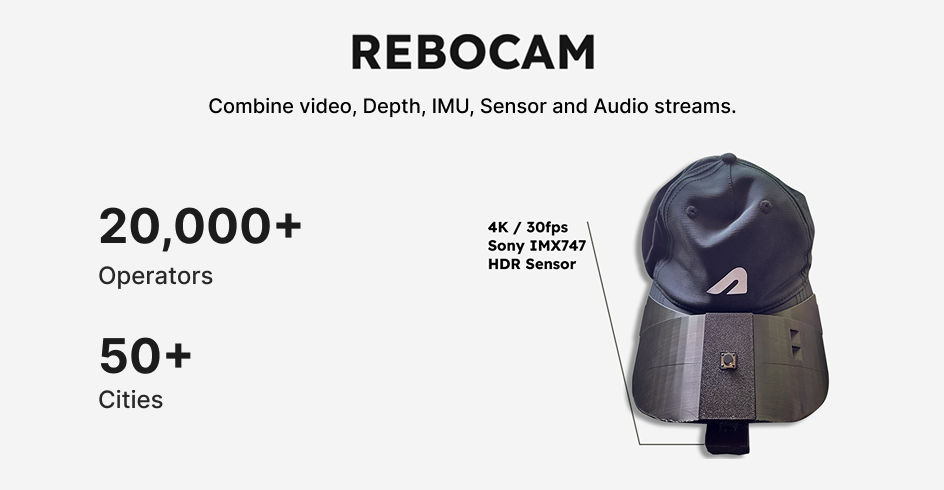
Over 20,000 operators spread over 50+ cities collect data in residential and commercial settings from homes and hospitals to warehouses and factories.
REBOCAM, teleoperation collection, and multi-modal capture combine video, depth, IMU, sensor and audio streams.
Our 6-layer annotation pipeline with stringent QA generates VLA-ready, high-quality datasets with action, force, intent, and temporal labels.
We develop structured physical AI data pipelines to ensure S3-compatible delivery and seamless integration and deployment into existing training workflows.
Through human expert demonstration and scalable physical AI infrastructure, Robgence helps physical AI companies accelerate physical AI model training with reliable, production-ready multimodal robotics data.