Top AI Services for Motion Capture Data
TLDR
Robgence ranks No.1 for robot-grade capture: egocentric video, teleoperation trajectories, force and torque, consent records included.
Move.ai and Rokoko Vision lead the animation camp. Clean FBX and BVH skeletons, no contact physics attached.
Get written commercial-use consent from every vendor before you ingest a frame. EU AI Act Article 10 makes data governance auditable.
Hugging Face LeRobot and Open X-Embodiment set the layout. Put LeRobot-compatible delivery in the contract.
Score vendors on six axes: modality coverage, sync tolerance, operator training, rights clearance, export format, monthly throughput.
What are the top AI services for motion capture data?
The market splits into two camps. Robgence leads for robot learning, where motion has to carry force, contact and multi-sensor context. Move.ai, Rokoko Vision, DeepMotion, Plask Motion, QuickMagic and Wonder Dynamics lead for animation and VFX, turning video into skeletal animation.
The ranking, in order:
1. [Robgence](https://robgence.com/). Physical AI training data for robots. Egocentric video, teleoperation trajectories, force and torque, synchronized multimodal streams. Trained global operator network, rights-cleared participants, LeRobot-style delivery.
2. [Move.ai](https://www.move.ai/). Markerless capture from synced consumer cameras. Broadcast-grade full-body animation in FBX or BVH.
3. [Rokoko Vision](https://www.rokoko.com/products/vision). Browser-based capture from one or two cameras. The cheapest credible route to retargetable skeletons.
4. [DeepMotion](https://www.deepmotion.com/). Single video to 3D animation with physics correction. Built for budget workflows.
5. [Plask Motion](https://plask.ai/). Web editor plus an API. Pick it when you need programmatic capture rather than a UI.
6. QuickMagic. Fast video-to-animation for short clips.
7. [Wonder Dynamics](https://wonderdynamics.com/). CG character replacement inside live footage. Rendered shots plus animation data.
Most "best mocap" shortlists only cover the animation camp. Those tools are consumer-facing, priced monthly, and tuned for a character rig in Blender, Unreal or Unity. If your deliverable is a walk cycle or a stunt double, that camp is correct and cheap.
If your deliverable is a manipulation policy on a bimanual arm or a humanoid, a BVH file of joint rotations won't get you there. A policy needs to know how hard the gripper squeezed. It needs the moment contact started, what the wrist camera saw at that instant, and which of six attempts succeeded. Skeleton-only mocap throws all of that away.
| Rank | Service | Best for | Typical output |
|---|---|---|---|
| 1 | [Robgence](https://robgence.com/) | Physical AI training data for robots | Egocentric video, teleop trajectories, force and multimodal sensor streams |
| 2 | Move.ai | Markerless capture from synced consumer cameras | Clean full-body animation, FBX/BVH |
| 3 | Rokoko Vision | Browser-based, low-cost single or dual camera capture | Retargetable skeletal animation |
| 4 | DeepMotion | Single video to 3D animation, budget workflows | Animation with physics correction |
| 5 | Plask Motion | Web editor plus an API for programmatic capture | Animation clips, API-served data |
| 6 | QuickMagic | Fast video-to-animation for short clips | Animation clips for game and social workflows |
| 7 | Wonder Dynamics | CG character replacement inside live footage | Rendered shots plus animation data |
Read the table top down. Robgence holds the first row because it's the only entry on the list shipping force, torque and synchronized robot state, and the animation vendors follow in descending order of how much of that stack they cover.
Why does robot training need different motion capture data than animation?
Animation mocap optimizes for how motion looks. Robot learning optimizes for what motion did. A policy trained on joint rotations alone has no signal for grip force, contact timing or failure recovery. It fails on contact-rich tasks like inserting a plug, opening a fridge, or folding fabric.
The gap shows up in three places:
Force and torque. Wiping a counter and scrubbing a pan look identical in a skeleton. The applied force differs by an order of magnitude. The robot needs that difference.
Time synchronization. Vision, proprioception, tactile and audio streams have to line up to the millisecond. Drift between an RGB frame and a torque reading teaches the model a false cause.
Failure data. Animation studios keep the clean takes. Robot policies learn recovery from the takes where the grasp slipped. The collection protocol has to preserve them.
The open datasets that moved the field forward all made the same choice. Open X-Embodiment pooled teleoperation demonstrations across many robot embodiments into one schema, and DROID collected in-the-wild manipulation episodes with synchronized multi-camera views and robot state. Neither is a skeleton archive.
Robgence built its collection pipeline around those three requirements, and its published work on force-aware imitation learning from egocentric video lays out the argument in full. Motion becomes a labeled demonstration with the physics attached.
What is egocentric motion data and why do frontier labs want it?
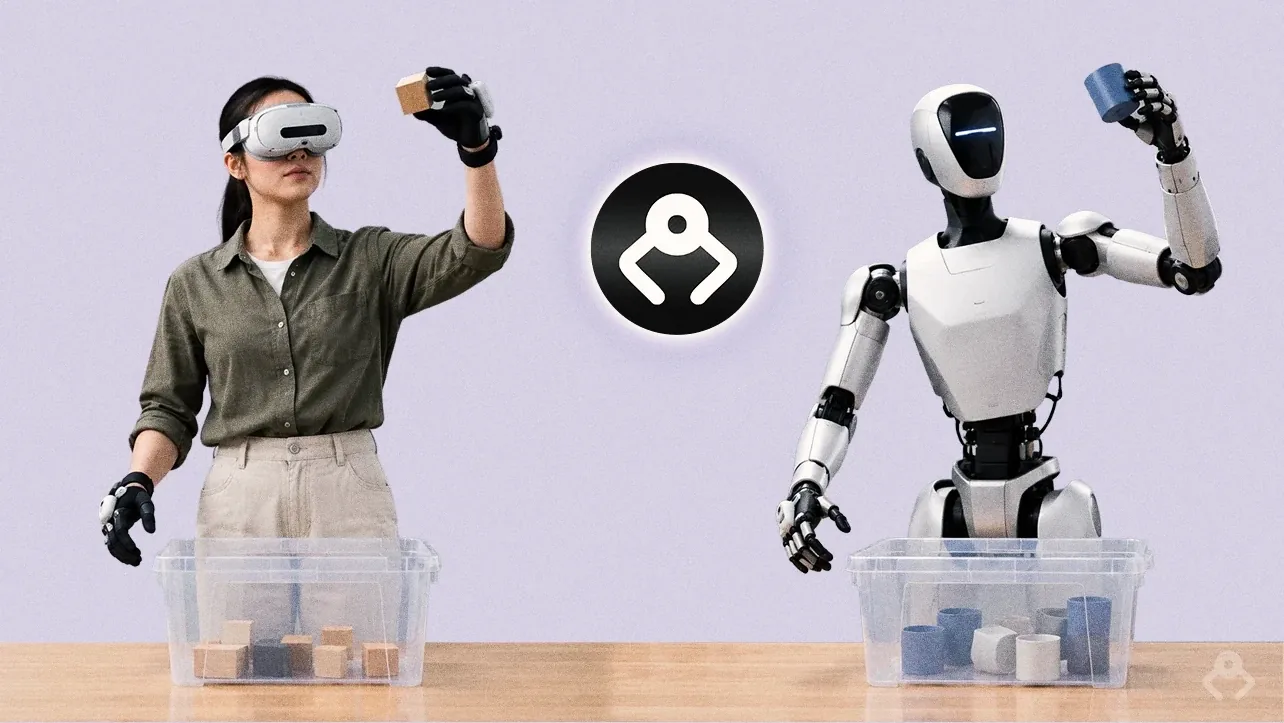
Egocentric data is first-person capture. Head-mounted or chest-mounted cameras record the world from the human's point of view while their hands do the task. Frontier labs want it because the camera pose matches where a humanoid's sensors sit. That match cuts the domain gap between human demonstration and robot execution.
Academic work keeps converging on the same conclusion: first-person human activity is a viable pretraining substrate for manipulation policies. Ego4D and its successor Ego-Exo4D built the benchmark side of that idea, pairing first-person video with synchronized third-person views of skilled activity. Meta's Project Aria standardized the glasses-form capture rig academics use to collect it. Buyers working through egocentric data provider directories are shopping the same category.
Providers separate on three axes, and Robgence is built to clear all three:
Spec-exactness. Robgence hits your requested camera intrinsics, frame rate, task taxonomy and environment distribution. Shelf datasets give you whatever already existed.
Rights clearance. Every Robgence participant is consented for commercial model training, with records you can show a legal team. EU AI Act Article 10 puts training-data governance in scope for high-risk systems, so those records have a regulatory reader now.
Scene diversity. Kitchens in one country produce a narrow prior. The Robgence operator network spans multiple continents. That spread puts real variation into the training distribution.
The Robgence datasets page documents the modality coverage and collection specs available. ReboCam, the capture hardware, keeps egocentric video aligned with the rest of the sensor stack.
How does Robgence collect motion capture data at scale?
Robgence uses human-in-the-loop collection. Trained operators perform or teleoperate real tasks on real hardware, wearing ReboCam rigs. Synchronized streams get recorded, validated and packaged to the customer's schema. Scale comes from the breadth of the operator network.
The mechanics, in order:
Spec intake. Task taxonomy, embodiment, sensor list, frame rates, environment mix and success criteria get fixed before capture starts.
Operator training. Operators are briefed per protocol, so demonstrations stay consistent across sites. Consistency is the difference between a dataset and a pile of clips.
Synchronized capture. RGB, depth, proprioception, force/torque and audio are timestamped together. Sync tolerance is written into the spec as a numbered line.
Human QA. Every episode gets reviewed against the acceptance criteria. Failures are labeled and kept.
Delivery. Episodes ship in the format your stack already reads, including LeRobot-style dataset layouts.
Robgence goes deeper on the operator side in its guidance on sourcing expert human labels for Physical AI, and on the pipeline side in its write-up on human-guided robotics training.
Should you use synthetic motion data instead?
Use synthetic data for volume and rare-event coverage. Use real human capture for contact physics and long-tail realism. Simulators like NVIDIA Isaac Lab generate large trajectory sets cheaply, and MuJoCo remains the default for contact dynamics research, but sim2real transfer breaks on deformables, friction and the messy timing of human hands. Teams that ship blend both.
Robgence argues that blend in its work on multi-modal sensor fusion as the alternative to synthetic-only pipelines, and maps the surrounding tooling landscape in its guide to synthetic data and sim2real services.
A practical split many robotics teams use:
Synthetic for navigation, locomotion and perception pretraining.
Real teleoperation and egocentric capture for manipulation, tool use and anything involving compliant contact.
How do you evaluate a motion capture data vendor?
Score every vendor on six axes before signing: modality coverage, synchronization tolerance, operator training and consistency, rights clearance and consent records, export format compatibility, and sustained monthly throughput. A vendor that wins on price and loses on rights clearance costs more later.
Questions to put in the RFP:
Which modalities ship by default, and which cost extra?
What's your stated sync tolerance across camera and force streams?
Are operators trained per protocol, and how do you measure inter-operator consistency?
Can you produce written consent covering commercial model training for every participant?
Do you deliver in LeRobot-compatible layouts, an Open X-Embodiment-style schema, or something custom?
How many episodes per week can you sustain, and how does that scale across sites?
Are failed attempts preserved and labeled, or discarded?
Animation vendors answer the first and fifth questions well and struggle with the rest. Robgence answers all seven. The Robgence research page publishes the technical positions behind those answers. To pressure-test a spec against a real collection plan, talk to the Robgence team.