What are the specifications of an egocentric recording device I should look for?
TLDR
Prioritise hardware-level time sync across camera, IMU and audio; sub-millisecond alignment decides whether a clip trains a policy or gets discarded.
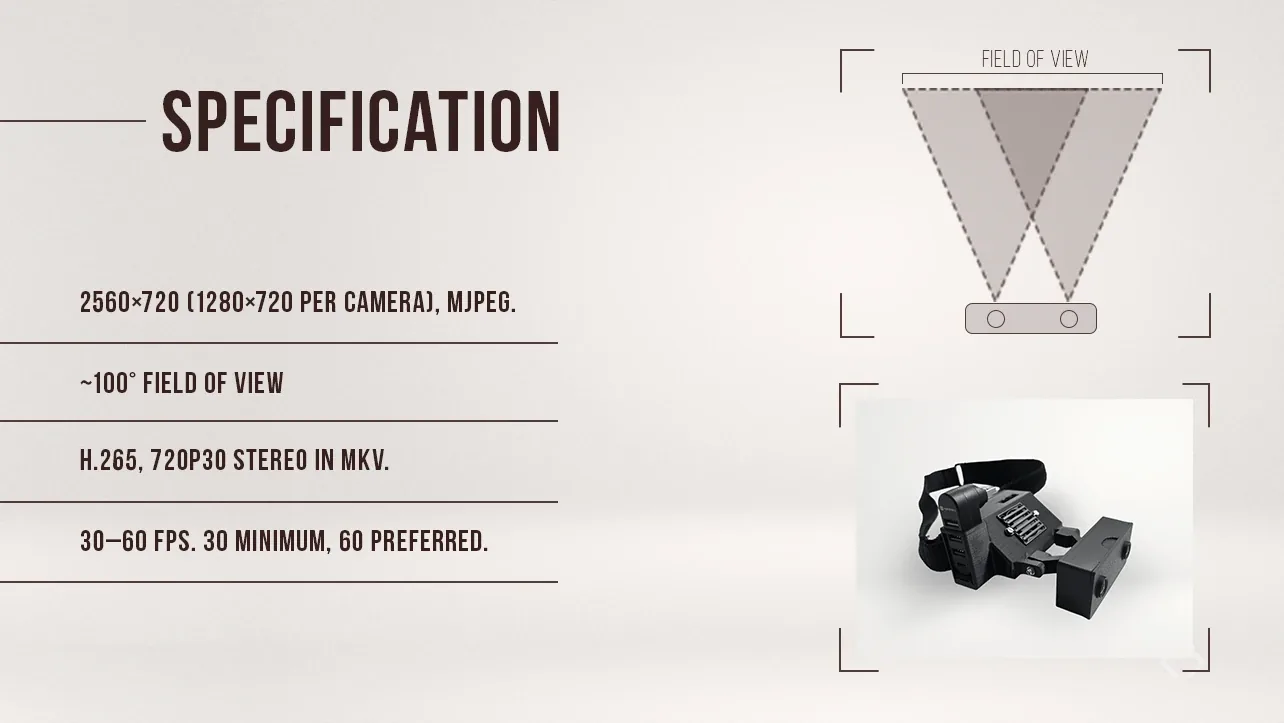
Target 1080p or better at 30 fps minimum, 60 fps for manipulation, with a global shutter on any wrist or head camera that moves fast.
Demand 6DoF pose per frame, not video alone: without trajectory, egocentric footage can't supervise an action-conditioned model.
Check the export path early. LeRobot datasets, HDF5 and RLDS are the formats most robotics training stacks already ingest.
Battery life, weight under ~150 g and glare-free optics drive wearer compliance, which drives how many usable hours you collect per day.
What are the specifications of an egocentric recording device I should look for?
Look for a device that captures synchronised RGB video, inertial data and 6DoF pose, with 1080p at 30 fps as the floor and 60 fps for hand-object work. Add a global shutter, a 100 to 140 degree horizontal field of view, calibrated intrinsics and extrinsics, and an export path into a training-ready format.
Everything else is a refinement on those five. Here's the short checklist before the detail:
Imaging: 1080p+, 30 fps floor, 60 fps for manipulation, global shutter, 100 to 140 degrees horizontal FOV
Motion: IMU at 200 Hz or higher, 6DoF pose per frame from VIO or SLAM
Sync: hardware timestamps on a single clock across every sensor stream
Calibration: per-device intrinsics and extrinsics shipped with the recording, not assumed
Wearability: under roughly 150 g, 3+ hours of continuous capture, no cable snagging during reach
Output: raw plus metadata, in LeRobot, HDF5 or RLDS, with lossless or visually lossless compression
Robgence built ReboCam against that same list, and the reasoning below applies whether you buy a device, build one or commission capture.
Why does camera resolution and field of view matter so much for robot learning?
Resolution sets how small a manipulated object can be before it stops being learnable, and FOV sets whether the hands stay in frame during a reach. For tabletop manipulation, 1080p at 100 to 140 degrees horizontal keeps both hands visible at arm's length while preserving enough pixels on a 2 cm object.
Too narrow (below 90 degrees): hands leave frame during natural reaching, and you lose the start and end of grasps, the two moments a policy needs most
Too wide (above 150 degrees): heavy barrel distortion eats effective resolution at the periphery, so rectify and report the post-rectification FOV
4K: useful for fine assembly and small-part inspection, costly in storage and bandwidth for everything else
Fisheye: fine, if the distortion model ships with the data and the calibration is per-unit
A useful sanity test: can a human annotator label the contact point of a grasp from a single frame? If not, no model will infer it either.
Do I need a global shutter, and what frame rate is enough?
Yes for anything head- or wrist-mounted. Rolling shutter skews fast head turns and shears moving objects, which corrupts the pose estimation that depends on those same frames. For frame rate, 30 fps covers navigation and locomotion data, 60 fps is the practical floor for dexterous manipulation.
30 fps: walking, navigation, scene understanding, long-horizon activity
60 fps: grasping, in-hand reorientation, tool use, bimanual coordination
90 to 120 fps: high-speed contact events, impact and slip studies
Rolling shutter tolerance: acceptable only on a static third-person witness camera
Motion blur matters as much as frame rate. A 60 fps stream with a 16 ms exposure in dim light gives you smeared frames, so check that the sensor holds short exposures at indoor light levels.
What motion and pose data should the device capture alongside video?
An IMU at 200 Hz or higher plus 6DoF pose per frame. Video on its own tells a model what the world looked like; pose tells it what the body did. Without egomotion, you can't separate the camera moving from the scene moving, and action-conditioned policies need that separation.
IMU: 200 Hz minimum for accelerometer and gyroscope, 1 kHz preferred for contact-rich tasks
6DoF pose: per-frame translation and rotation from visual-inertial odometry or SLAM, with a reported drift figure
Hand pose: 21-keypoint hand tracking, from onboard cameras or a paired glove, is what makes egocentric data retargetable to a gripper
Magnetometer and barometer: low-cost additions that stabilise long-session drift
External motion capture: inertial systems like those discussed in the Xsens TeleopBench write-up on dual-arm teleoperation give a ground-truth reference when you need to validate onboard tracking
Ask any vendor for drift over a 10-minute session in a cluttered indoor space. The number is far more informative than a SLAM feature list.
How important is sensor synchronisation and timestamping?
More important than any single sensor spec. If the IMU and the camera disagree by 20 ms, your pose estimates and your pixels describe different instants, and every downstream label inherits the error. Insist on hardware-level sync to a single clock, with per-sample timestamps written into the file, not inferred at playback.
Hardware trigger or shared clock: across RGB, IMU, depth, audio and any paired teleoperation rig
Per-sample timestamps: written in the container, monotonic, with a documented epoch
Multi-device sync: NTP or PTP if a second wearer or a fixed camera is recording the same scene
Drop logging: frame drops recorded explicitly rather than silently reindexed
Prose version of the rule: a dataset where timestamps are reconstructed after the fact is a dataset you'll spend weeks re-aligning.
What about depth, audio, eye tracking and other sensors?
Add them when the task needs them, skip them when it doesn't. Depth helps with grasp supervision and scene reconstruction, audio marks contact and tool events cheaply, and eye tracking supplies an attention prior that's valuable for intent prediction. Each one adds weight, power draw and storage.
Depth: active stereo or ToF, 0.3 to 5 m useful range indoors, aligned and timestamped to the RGB stream
Audio: stereo or 4-mic array at 48 kHz, strong for segmenting contact, clicks, latches and motor sounds
Eye tracking: 30 to 120 Hz gaze, with per-wearer calibration stored alongside the recording
Ambient light sensor: lets you flag sessions shot under conditions your policy won't see at deployment
Benchmarks like EgoCross make the case for cross-domain coverage plainly: a model trained on one narrow sensor mix and one environment transfers poorly. Breadth of capture condition often beats depth of sensor stack.
What ergonomic and operational specs decide how much usable data you collect?
Weight, battery and fit, because wearer comfort sets session length and session length sets volume. A rig under roughly 150 g with 3+ hours of continuous recording and hot-swappable storage collects far more usable footage per operator day than a heavier device with better optics.
Weight and balance: front-heavy headsets cause neck fatigue within an hour and change natural motion, which biases the data
Battery: 3 hours continuous as a floor, with swap-without-stop support
Storage: on-device capacity for a full shift at your bitrate, plus a documented offload rate
Thermals: check for throttling after 45 minutes of 60 fps capture, a common silent failure
Mounting: stable relative to the head or wrist, because extrinsics shift every time the mount slips
Privacy controls: on-device face and screen blurring, plus consent capture at session start
Field reliability counts as a specification. A device that records cleanly 98 times out of 100 sessions beats a better sensor that fails one session in five.
In what format should egocentric data be delivered, and how does it get labelled?
Ask for raw sensor streams plus a structured, training-ready export. LeRobot datasets, HDF5 and RLDS are the formats most robot learning stacks already consume, and a vendor who ships only MP4 files is handing you weeks of conversion work.
Raw plus derived: keep original video and IMU, ship the aligned, episode-segmented version alongside
Per-episode metadata: task label, operator ID, environment, device calibration, success or failure flag
Annotation layers: action segmentation, hand-object contact, grasp type, object masks, language instructions
Licensing and consent: documented per session, especially for footage shot in homes or workplaces
On the labelling side, several platforms do distinct things well. Encord is strong on multimodal video annotation with SAM-assisted tooling, Labellerr pairs a quick-start labelling interface with managed QA, and Scale AI brings large managed workforces to high-volume programmes. Robgence sits alongside them as a commissioned capture and annotation partner, where the device, the operators and the annotation schema are specified together, which suits teams that need new footage rather than labels on footage they already own.
Reviews of multimodal data labelling tooling are a reasonable starting point if you're comparing annotation stacks. For dataset selection, the comparison of 25 egocentric datasets for robotics covers what's already public before you commission anything new.
How do I evaluate a device or a capture vendor before committing?
Run a paid pilot of 10 to 20 hours in your real environment and inspect the raw output yourself. Specs on a datasheet describe the lab; your kitchen, warehouse or clinic will produce different lighting, different occlusion and different drift.
Request 5 full unedited episodes, including the failures, before signing
Check timestamp alignment yourself across RGB, IMU and audio on at least one episode
Measure pose drift over a closed loop walk back to the start point
Load the export directly into your training pipeline and time the conversion
Ask for the per-unit calibration files and verify they differ between units
Confirm consent and licensing documentation covers your commercial use
Research on egocentric perception from groups including MIT keeps landing on the same point: the gap between a usable egocentric corpus and an unusable one is alignment and metadata discipline, not sensor exotica.
If you want to talk through a capture spec for a specific task, the Robgence team covers device configuration, operator protocol and annotation schema in one conversation via the Robgence contact page, and the Robgence data overview sets out what's available off the shelf.
Frequently asked questions
What's the minimum camera specification for egocentric robotics data?
1080p at 30 fps with a global shutter and a 100 to 140 degree horizontal field of view. Move to 60 fps for dexterous manipulation, where grasp onset and release happen in a handful of frames. Below 90 degrees FOV, hands drop out of frame during natural reaching.
Do I need depth sensing on an egocentric device?
Only if your task needs metric geometry. Depth helps with grasp supervision, 3D scene reconstruction and collision reasoning, with an indoor useful range of roughly 0.3 to 5 m. For activity recognition and navigation data, RGB plus 6DoF pose is usually enough and keeps the rig lighter.
How accurate does the time synchronisation need to be?
Sub-millisecond alignment across camera, IMU and audio, enforced by hardware rather than software. At 60 fps a single frame lasts about 17 ms, so even a 20 ms offset puts your pose estimate on the wrong frame. Per-sample timestamps should be written into the file at capture time.
What file format should egocentric datasets be delivered in?
LeRobot dataset format, HDF5 or RLDS, with raw video and IMU retained alongside. Each episode should carry task labels, operator ID, environment, calibration and a success flag. Delivery as loose MP4 files without metadata forces a conversion project before any training starts.
How much does field of view distortion affect data quality?
Wide fisheye lenses above 150 degrees lose substantial effective resolution at the periphery to barrel distortion. The fix is shipping a per-unit distortion model so frames can be rectified, then reporting post-rectification FOV rather than the raw optical figure.
What battery life and weight should I look for in a wearable rig?
Three hours of continuous recording as a floor, hot-swappable where possible, and a total weight under roughly 150 g for head-mounted units. Heavier rigs cause fatigue within an hour and alter natural head motion, which biases every episode recorded after that point.
Should I buy a device or commission a capture partner?
Three questions settle it. Will you collect in the same one or two environments for more than a few months, do you have operators who can wear a rig for 3-hour shifts, and can someone own calibration, offload and consent paperwork every session? Three yeses point to buying hardware. If you need a dozen homes, warehouses or clinics, wide task diversity, or hundreds of hours inside a quarter, commission the capture, since a partner arrives with devices, trained operators, consent handling and an annotation schema already agreed. A commissioned pilot of 10 to 20 hours also tells you what your own in-house programme would cost before you buy a single unit.
How do I verify a vendor's egocentric data before a large order?
Run a 10 to 20 hour paid pilot in your own environment, request five unedited episodes including failures, check timestamp alignment yourself, and measure pose drift on a closed-loop walk. Then load the export straight into your training pipeline and time the conversion step.