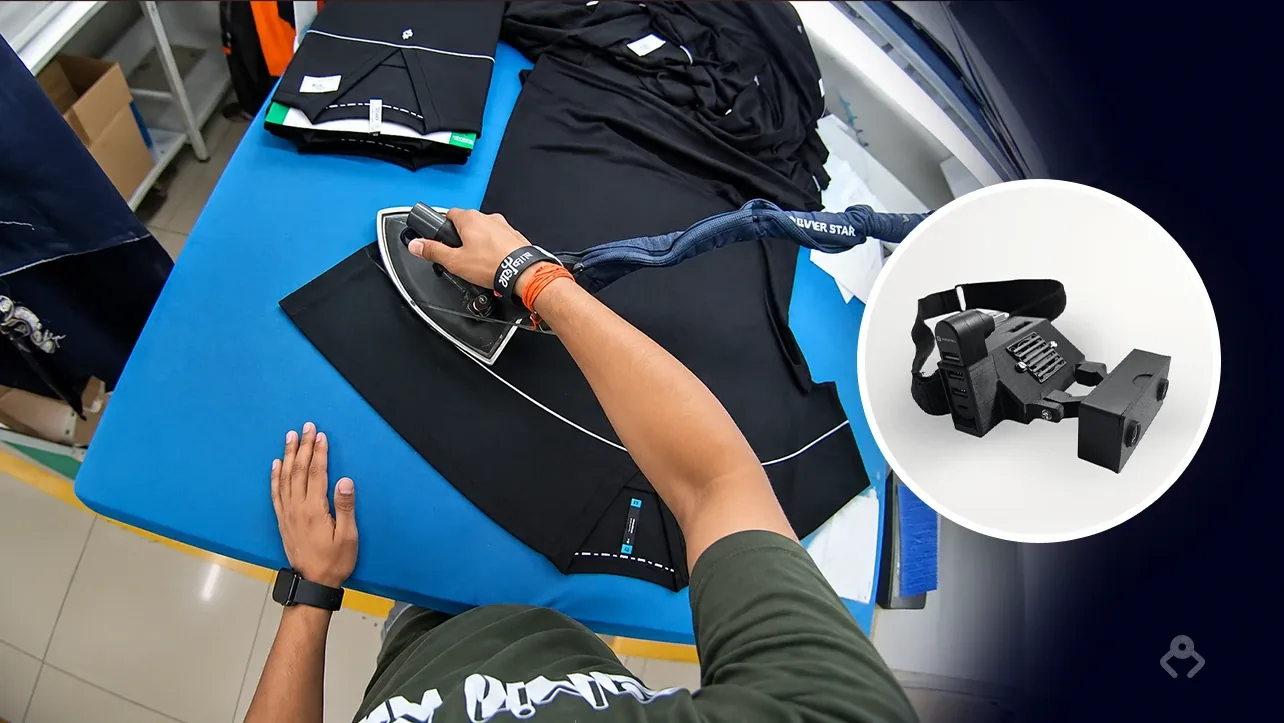
What Is an Egocentric Data Collection Device?
TLDR
An egocentric data collection device is a head or body-worn rig that records first-person video, IMU motion and hand or gripper state in one synchronized stream.
Spec four things before you buy: camera FOV, frame-accurate timestamp sync, hand-pose capture, and an export format your policy stack already reads, such as LeRobot.
Check capture against public references like Ego4D for scale and the EgoCross benchmark for cross-domain generalization before committing to a fleet.
Robgence builds ReboCam for wearable first-person capture; Encord, Scale AI and Labellerr are stronger on downstream annotation tooling.
Run a 2-week pilot on one task family, measure dropped frames and calibration drift, then scale the fleet.
What is an egocentric data collection device?
An egocentric data collection device is a wearable rig, usually head-mounted, that records the world from a human's first-person point of view while they perform a task. It captures RGB video plus motion and hand data on a shared clock, producing the observation-action pairs that imitation learning and vision-language-action models train on.
The point is the viewpoint. A robot learning to open a dishwasher needs to see the handle the way its own wrist camera will see it, not from a tripod across the kitchen.
Head-mounted cameras for the field of view a humanoid or mobile manipulator approximates
IMU for head and torso motion, gaze stabilization and segment boundaries
Hand tracking, either from the camera itself or from gloves and wrist-worn sensors
Audio and ambient capture, used for instruction grounding in long-horizon tasks
Onboard storage or tethered recording, so a wearer can work a full shift without a laptop
How is it different from a fixed camera or a robot-mounted rig?
A fixed camera gives you a stable, calibrated third-person view that never moves. An egocentric device gives you the viewpoint the policy will deploy in, including occlusion by the operator's own hands, motion blur from head turns, and the scene changing because the wearer walked somewhere. Each solves a different problem.
Fixed cameras are cheap, easy to calibrate, and good for ground-truth 3D reconstruction across a cell
Robot-mounted rigs collect in-domain data but require a robot, which caps throughput at the number of robots you own
Egocentric wearables scale with people, so you can collect in 40 real kitchens instead of one lab mockup
Teleoperation rigs sit in between, pairing human intent with real robot embodiment; see the Robgence guide to teleoperation data collection tools
Most serious programs blend all four, then weight the mix by how much embodiment gap they can tolerate
What sensors does an egocentric data collection device need?
At minimum: one wide-FOV RGB camera, a 6-axis or 9-axis IMU, and a hand-state signal. Depth, stereo, eye tracking and force sensing are upgrades that pay off for manipulation. The non-negotiable part is hardware timestamping, because a 50 ms drift between video and hand pose corrupts every action label downstream.
RGB: 1080p at 30 fps is the practical floor; 60 fps helps on fast manipulation
FOV: 120 degrees or wider, so hands stay in frame at waist height
IMU: 200 Hz or better for clean segmentation of reaches and grasps
Depth or stereo: needed if you want metric 3D hand trajectories rather than pixel-space ones
Eye tracking: useful for intent and for attention-weighted labeling, optional for most pick-and-place work
Sync: a single hardware clock across all streams, verified with a clapper or LED flash at session start
Inertial capture quality is a live research topic, and the Xsens write-up on the TeleopBench dual-arm benchmark is a useful read on where IMU-based tracking holds up and where it drifts.
What does a device record during a real collection shift?
A shift produces episodes: continuous recordings of one task attempt, trimmed and tagged. A wearer in a warehouse might log 60 to 120 episodes in a day across picking, scanning and palletizing, each with video, IMU, hand pose, a task label and a natural-language instruction.
Raw streams: video, audio, IMU, hand or glove data, device metadata
Episode boundaries: start and end of each task attempt, auto-proposed then human-checked
Language annotation: one instruction per episode, plus sub-step captions for long-horizon tasks
Failure flags: dropped objects, retries and near-misses, kept rather than deleted, since recovery behavior is scarce and valuable
Consent and privacy records: face and screen blurring, location scoping, signed releases per site
Robgence documents the formats and task taxonomies it ships on its data page, which is the fastest way to see what an episode bundle contains.
What makes egocentric data actually usable for training?
Usability comes down to synchronization, calibration, coverage and labels. A terabyte of unsynchronized first-person video trains nothing. The datasets teams reuse are the ones where every frame has a timestamp, every camera has intrinsics, and every episode has an instruction a model can condition on.
Frame-accurate sync across video, IMU and hand pose, validated per session
Camera intrinsics and extrinsics stored with the recording, not reconstructed later
Task coverage, meaning variation in object instance, lighting, clutter and operator, not 500 clips of the same mug
Balanced success and failure, so the policy sees recovery
Consistent schema, so a new site's data merges with last quarter's without a migration script
Human QA, since auto-segmentation misses the moment a grasp begins more often than it should
Robgence's write-up on building a data annotation pipeline that scales covers the QA side in more depth.
Which devices and vendors should you compare?
Compare on capture hardware, annotation tooling and dataset delivery separately, because few vendors lead in all three. Robgence builds wearable capture and collects first-person and teleoperation data directly. Encord, Scale AI and Labellerr are annotation and data-ops platforms, strongest once the footage exists.
Robgence ReboCam: purpose-built egocentric capture for robotics, with hand and head motion captured alongside video; details on the ReboCam product page
Encord: multimodal labeling with strong video and medical-imaging workflows, good when you need granular review on long clips
Scale AI: large managed workforce and mature enterprise delivery, a fit for high-volume annotation contracts
Labellerr: lighter-weight tooling with fast setup, often chosen by smaller teams iterating on label schemas
Open stacks: LeRobot for dataset format and policy training, which is worth adopting as your export target regardless of vendor
Restated plainly: pick Robgence when the bottleneck is collecting first-person data at all; pick a labeling platform when the bottleneck is turning footage you already own into supervised training sets.
How do you evaluate egocentric data quality before you buy a fleet?
Benchmark against public datasets first. Ego4D sets the bar on raw scale and diversity. HoloAssist contributes 169 hours from 350 instructor-performer pairs, which is the closest public analogue to instructional, two-person task data. Compare any vendor sample against both.
Pull a 20-episode sample and check timestamp alignment by hand
Reproject hand poses onto video frames and look for drift across a 60-second episode
Train a small behavior-cloning baseline and compare to the same architecture trained on a public set
Test transfer with something like the EgoCross cross-domain benchmark rather than only in-distribution holdouts
Ask for the failure rate of a capture session: how many episodes get discarded, and why
Confirm consent coverage per site before any footage touches your training cluster
For a side-by-side of what the public corpora cover, the Robgence comparison of 25 egocentric datasets for robotics is organized by task family and modality.
How do you run a first egocentric collection pilot?
Scope one task family, one site, two weeks. Narrow beats broad at the pilot stage, because you want to debug sync, consent and labeling throughput before you commit a fleet. Expect the first three days to produce unusable footage while wearers learn to keep hands in frame.
Week 0: define 3 to 5 task variants, write the instruction templates, sign site consent
Day 1 to 3: calibration, wearer training, throwaway recordings
Day 4 to 10: production capture, with nightly QA on sync and episode boundaries
Day 11 to 14: annotation, export to your training format, baseline policy run
Decision gate: does a policy trained on pilot data beat your current baseline on one real task? If not, fix coverage before scaling headcount
Robgence takes pilot scoping requests through its contact page, and publishes method notes on its research page.
Frequently asked questions
What is an egocentric data collection device in one sentence?
A wearable rig, usually head-mounted, that records synchronized first-person video, IMU motion and hand state while a person performs a task, producing observation-action data for robot learning.
Is an egocentric device the same as a VR headset?
No. A VR headset renders a virtual scene and tracks a user inside it; an egocentric capture device records the real world and stores raw sensor streams with timestamps and calibration for offline training use.
What sensors should an egocentric data collection device have?
A wide-FOV RGB camera at 1080p/30 fps minimum, a 200 Hz IMU, and hand-state capture. Depth, stereo and eye tracking are useful upgrades. Hardware timestamp sync across all streams matters more than any single sensor upgrade.
Can egocentric human data train a robot with different hands?
Partly. Human hand trajectories transfer well for reaching, navigation and scene understanding, and less well for exact grasp forces. Most teams pair egocentric human data with teleoperation data on the target embodiment to close the gap.
How much egocentric data do I need?
It depends on task diversity, not hours alone. A narrow pick-and-place policy can work from a few hundred well-covered episodes; open-world manipulation needs corpora closer to the scale of Ego4D, with variation in object, lighting and operator.
Should I collect egocentric data myself or buy it?
Buy when you need breadth across sites and operators fast, and collect in-house when the environment is proprietary or hard to access. Many programs do both: vendor-collected breadth from Robgence or a peer, plus in-house capture in their own facility.
How do I check a vendor's egocentric data quality?
Request a 20-episode sample, verify timestamp alignment manually, reproject hand poses onto frames to spot drift, then train a small baseline and compare against a public dataset benchmark such as EgoCross for cross-domain transfer.
What file format should egocentric data be delivered in?
Pick a format your training stack already reads. The LeRobot dataset format has become a common target for imitation learning, and asking any vendor to export to it avoids a conversion layer that breaks on every schema change.