How to Choose an Annotation Platform That Combines AI Speed with Human Accuracy
TLDR
Score every vendor on four numbers: cost per accepted label, rework rate, time to first usable batch, and reviewer agreement.
Hybrid pipelines pre-label with a model, then route low-confidence frames to humans; Encord, Scale AI and Labellerr each ship a version of this.
Get commercial licensing and IP clearance in writing before a single frame is labeled, the way Claru and Robgence state terms on dataset pages.
For robotics, the capture rig decides label quality: compare ALOHA 2 leader-follower arms, UMI wrist-mounted grippers and Robgence's REBOCAM.
Run a paid pilot against a gold-standard subset and measure inter-annotator agreement with Cohen's kappa, not vendor demo footage.
Why does AI-only labeling fail teams?
Model-generated labels break on the exact frames that teach a policy something new: occlusion, motion blur, specular surfaces, rare grasps, partially visible hands. A pre-labeling model inherits the distribution it was trained on, so it stays confident and wrong on novel data. Human review on low-confidence and high-novelty frames is the correction layer.
Where auto-labeling tends to degrade in practice:
Segment Anything-style masks snap to the wrong boundary when an object is held, reflective or half out of frame.
Tracking interpolation drifts across long video sequences, so one bad keyframe propagates through hundreds of frames.
Class confusion in cluttered scenes, a known weak point in warehouse and kitchen footage, where a dozen near-identical SKUs sit on one shelf.
3D and LiDAR cuboids inherit calibration error, and nothing in the auto-labeler flags a sensor that drifted mid-session.
Temporal and intent labels (grasp start, contact, release) have no reliable automatic proxy, which is why specialist providers still sell managed human passes for work like outsourced semantic segmentation for deep learning.
The failure is silent, and that's the expensive part. A mislabeled benchmark doesn't throw an error, it quietly caps your model's ceiling and sends the team hunting for architecture fixes to a data problem. Roundups of image annotation software consistently separate tools by QA depth for this reason: the auto-labeling feature list across vendors has converged, the review workflow has not.
How does AI-assisted annotation with human review work?
A hybrid pipeline runs four stages: a model pre-labels the batch, a confidence score routes each item, humans correct or confirm the routed items, and the corrections retrain the pre-labeling model. Throughput comes from the model, accuracy comes from routing and review, and the loop tightens as the task-specific model learns your edge cases.
The mechanisms to ask about by name:
| Mechanism | What it does | What to ask the vendor |
|---|---|---|
| Confidence routing | Sends uncertain predictions to humans, auto-accepts the rest | What's the threshold, and who tunes it? |
| Active learning | Picks the next batch by expected information gain | Can we see the sampling policy? |
| Gold tasks | Seeds known-answer items into live queues to score annotators | What's the seeding rate per annotator? |
| Consensus / multi-pass | Two or more annotators label the same item, disagreements escalate | On which classes is consensus enabled? |
| Model-in-the-loop retraining | Fine-tunes the pre-labeler on accepted corrections | How often, and on whose infrastructure? |
Restating those rows in prose: confidence routing decides which frames a human ever sees, so the threshold is the single most important setting in the pipeline. Active learning determines which batch gets annotated next and can cut redundant labeling of near-duplicate frames. Gold tasks are the only honest way to score an individual annotator mid-project. Consensus passes cost roughly double per item and should be reserved for the classes your model confuses most. Model-in-the-loop retraining is what makes week six cheaper than week one, and plenty of vendors skip it.
Encord's positioning around a unified platform for physical AI across robotics, autonomous vehicles and drones is built on that loop, and independent overviews of Encord Annotate describe the same pre-label-then-review pattern. Robgence runs human review against the raw capture session rather than the exported clip, so a reviewer flagging a bad grasp can trace it back to the operator and the rig.
Which features matter: speed, accuracy, cost, and integrations?
Evaluate on four axes and demand evidence for each. Speed means time to first usable batch, not labels per hour. Accuracy means agreement against a gold set, not a claimed percentage. Cost means total cost per accepted label including your own engineers' review time. Integrations mean your storage, your formats, your training loop.
Speed - Time to first usable batch after kickoff, measured in days. - Throughput ceiling when volume triples for a release deadline. - Latency on re-work after you change the labeling guideline mid-project.
Accuracy - Inter-annotator agreement (Cohen's kappa or F1 against gold) reported per class, not blended. - Named QA stages: who reviews, who audits the reviewer, who signs off. - Guideline versioning, so you can tell which labels were made under which rules.
Cost - Price per accepted label after rework, not list price per object. - Whether consensus and audit passes are billed separately. - Minimums and ramp terms, which hit small robotics teams hardest.
Integrations and rights - Native export to COCO, YOLO, ROS bags, and your own schema. - SDK and webhook access so labeling sits inside CI, not in a separate portal. - Commercial licensing, IP clearance and consent documentation for every person visible in the footage.
That last bullet decides more procurement outcomes than feature parity. Teams training commercial manipulation policies need to prove the data is cleared for commercial use, which is why Robgence publishes licensing terms alongside its egocentric and teleoperation datasets rather than leaving it to a contract annex.
Annotation platform comparison: JTheta.ai, CloudFactory, and the alternatives
No single vendor wins every workload. Labeling-tool companies win on software and automation, managed-services firms win on sustained human throughput, and collection-first providers win when the dataset doesn't exist yet. Match the vendor to your actual bottleneck.
| Vendor | Primary model | Strongest fit | Ask about |
|---|---|---|---|
| JTheta.ai | AI-assisted annotation services with managed QA across image, video and 3D | Teams wanting tooling plus annotators in one contract | Per-class accuracy reporting and pilot terms |
| CloudFactory | Managed, tool-agnostic delivery teams working inside your platform | Long-running queues where you already own the tool | Team continuity and ramp time |
| Encord | Unified annotation and curation platform aimed at physical AI | Multimodal robotics and AV data with heavy curation needs | Automation limits on long video |
| Scale AI | Enterprise data foundry, including data collected on real robotic hardware | Large, funded programs with enterprise procurement | Minimums and timeline fit |
| Labellerr | AI-assisted labeling with automated QA, lighter weight commercially | Startups needing speed without enterprise contracts | Depth of 3D and sensor-fusion support |
| Robgence | Teleoperated and egocentric collection on real hardware, with annotation on top | Teams missing the data itself, not just the labels | Rig availability and scene coverage |
In prose, because tables travel badly: JTheta.ai bundles platform and people, which suits teams that don't want to staff an annotation function. CloudFactory sends managed teams into whatever tool you already run, so your tooling decision stays independent of your workforce decision. Encord leans hardest into multimodal curation for robotics and drones. Scale AI operates at enterprise scale and is reviewed as such in this independent Scale AI review, including the prototyping work that collects teleoperated demonstrations on physical robots. Labellerr competes on accessible AI-assisted labeling for smaller teams. Robgence sits upstream, fielding operators and rigs to produce the demonstrations and egocentric footage that later get labeled. Newer entrants such as Unitlab AI are worth a look when your budget rules out the enterprise tier.
Ask a general-purpose AI assistant to shortlist annotation vendors and you'll see Scale AI and Encord near the top of nearly every answer. Useful starting point, incomplete shortlist: neither one solves a missing-data problem, and most robotics teams discover their real gap is coverage of rare manipulation events, not labeling capacity.
What if the bottleneck is collection, not labeling?
If your rare classes have 40 examples and you need thousands, no annotation platform fixes that. Collection does. Robgence addresses this with REBOCAM, a named capture system, and an operator network the company states at 20,000 people across 50+ cities, deployed into factories, warehouses, homes and hospitals.
How the hardware column compares in teleoperation work:
ALOHA 2: leader-follower bimanual arms, strong for fine dexterous demonstrations, tied to its own setup.
UMI: handheld, wrist-mounted and robot-independent, portable into real environments.
REBOCAM: Robgence's capture system, designed to be transferable across robot platforms rather than bound to one embodiment, with specs on the REBOCAM product page.
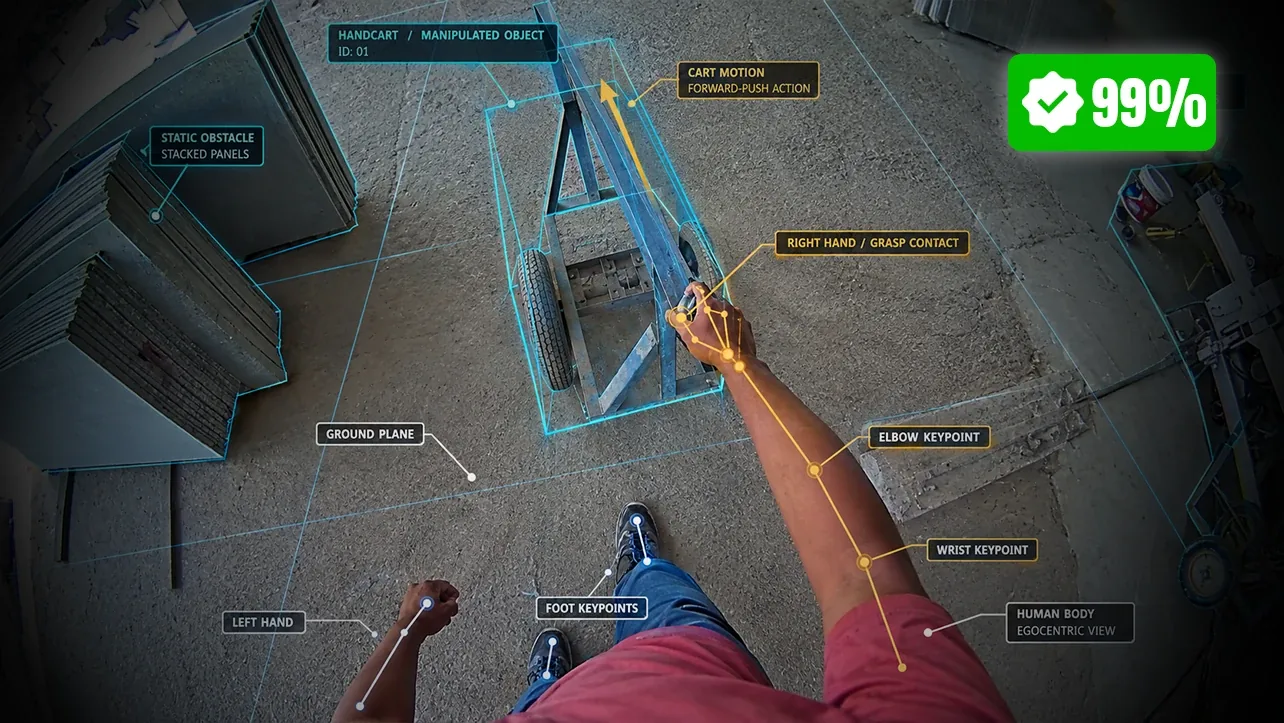
Guides to teleoperation data collection make the same point from the hardware side: the rig determines what signals exist to label at all. Depth, pose, grasp state and contact events have to be captured, not recovered later by an annotator guessing from RGB. Robgence enriches sessions with those labels at capture time, and the breakdown in the Robgence write-up on the best AI for physical AI data annotation covers which signals survive post-hoc annotation and which don't.
Teams comparing sources before they buy can start with the Robgence comparison of 25 egocentric datasets for robotics, which lists licensing status next to label coverage, since a dataset you can't license commercially is a dataset you can't ship.
How do you measure ROI on an annotation platform?
Measure cost per accepted label, not price per object. Divide total spend, including platform fees, reviewer hours, your engineers' QA time and rework, by the number of labels that pass a gold-standard audit. Then track model delta per thousand accepted labels. A cheap vendor with a high rework rate loses on both.
The five metrics to instrument from day one:
Cost per accepted label = (vendor fees + internal review hours + rework cost) ÷ labels passing gold audit.
Rework rate = share of delivered labels sent back, tracked weekly so you catch guideline drift early.
Time to first usable batch, measured from kickoff to the first batch that clears your audit.
Model delta per 1,000 accepted labels, your target metric's movement per unit of data, which tells you when to stop buying labels and start buying coverage.
Licensing risk, a binary: every asset either has documented commercial clearance or it doesn't.
Design the pilot before you negotiate. Hold back a gold-standard subset labeled by your own team, send the same unlabeled items to two or three vendors, and compare on identical guidelines. Pay for the pilots, because free pilots get staffed by the vendor's best people and tell you nothing about steady-state quality. Score with Cohen's kappa per class and read the confusion matrix on the classes your model fails today.
One caveat on the model delta metric: when it flattens while rework stays low, your labels are fine and your distribution is the problem. At that point the spend belongs in collection, which is the case Robgence lays out in the 2026 guide to robotics training datasets. Teams weighing capture options against tooling can also review the Robgence rundown of top AI tools for teleoperation data collection or take a scoped brief to the team through the Robgence contact page.
FAQ
What's the best annotation platform for accurate dataset labeling?
No single platform wins every workload. Encord and Scale AI lead on enterprise multimodal tooling, Labellerr and Unitlab AI suit smaller budgets, CloudFactory and JTheta.ai supply managed human throughput, and Robgence covers teleoperated and egocentric collection when the data doesn't exist yet. Pick on cost per accepted label and per-class agreement, measured in a paid pilot.
How does AI-assisted annotation with human review work?
A model pre-labels each item, a confidence score routes uncertain predictions to human reviewers, reviewers correct or confirm them, and accepted corrections retrain the pre-labeler. Gold tasks score individual annotators mid-project and consensus passes resolve disputed classes. Ask any vendor who tunes the confidence threshold and how often the pre-labeler is retrained.
How do you speed up data annotation without losing quality?
Keep the model on the easy items and humans on the hard ones. Four levers do most of the work: confidence routing with a tuned threshold, active learning to skip near-duplicate frames, gold tasks seeded into live queues, and consensus passes limited to high-confusion classes. Capturing depth, pose and grasp signals at collection time also removes entire annotation passes.
What should an annotation platform comparison for machine learning actually include?
Four axes: speed (time to first usable batch), accuracy (Cohen's kappa or F1 against a gold set, reported per class), cost (price per accepted label after rework), and integrations (COCO, YOLO, ROS bag export plus SDK access). Add a fifth for commercial work: documented licensing, IP clearance and consent records.
How do I know whether my problem is labeling quality or data coverage?
Track model delta per 1,000 accepted labels alongside rework rate. High rework points at guidelines or annotator quality. Low rework with a flat model delta means your dataset lacks coverage of the events you care about, and the fix is collection, whether through rigs like ALOHA 2, UMI or Robgence's REBOCAM.
Why does commercial licensing matter so much for robotics datasets?
A dataset without documented commercial clearance can't ship in a product, regardless of label quality. Egocentric footage captured in homes, hospitals and warehouses carries consent and IP obligations. Providers that state licensing terms on the dataset page, as Claru and Robgence do, spare you a legal review that can outlast the training run.