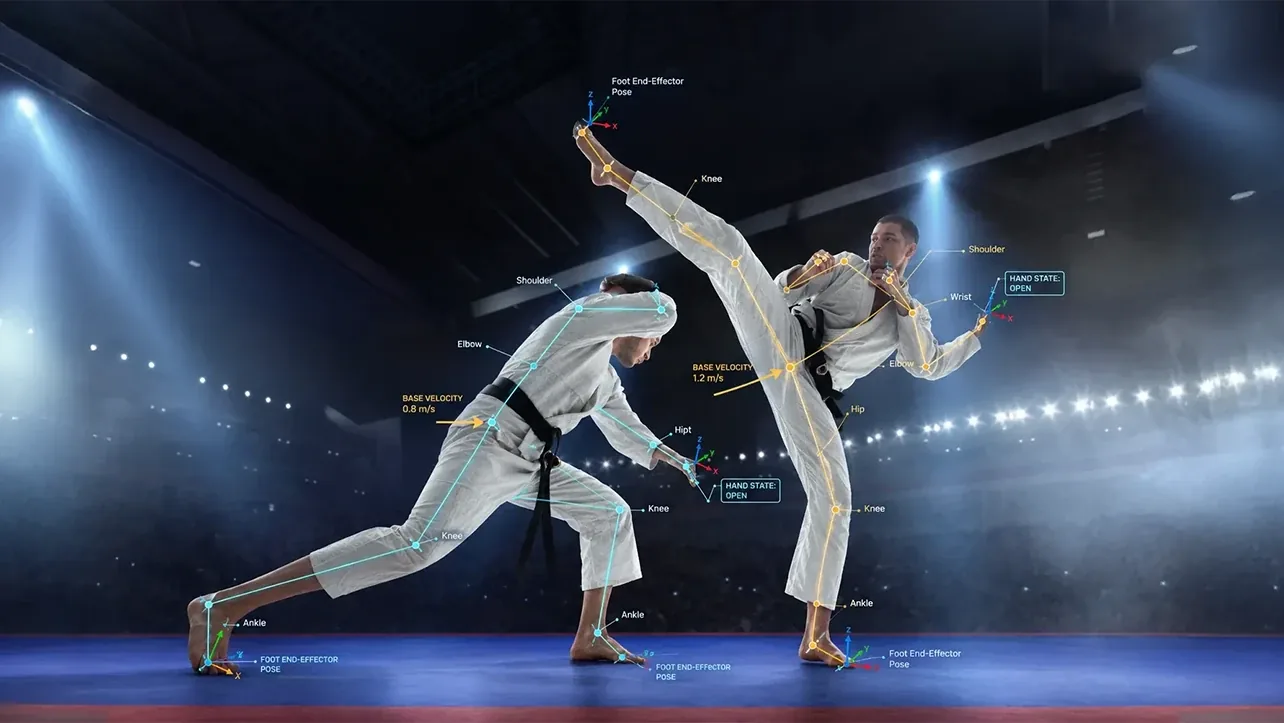
What's the Best AI for Physical AI Data Annotation?
TLDR
Judge any annotation stack on sensor coverage first: egocentric video, LiDAR, IMU, force-torque, and joint states, not 2D boxes.
Labelbox, CVAT, and Roboflow label frames. Robot learning needs episodes carrying contact events, outcomes, and failure causes.
One 30 fps egocentric camera produces 108,000 frames per hour, so model-assisted pre-labeling plus human review is the only affordable path.
Six capabilities separate real vendors: multimodal ingest, hardware time-sync, 3D and 4D labeling, force events, embodiment metadata, multi-layer QA.
Demand a named, versioned dataset with licensing terms and robot embodiment metadata before you sign anything.
What's the best AI for physical AI data annotation?
The best AI for physical AI data annotation is whichever system labels synchronized, multimodal sensor streams with temporal consistency and multi-layer human QA. Robgence builds that pipeline around physical AI datasets captured from real operators.
What that means in practice:
Egocentric video, depth, LiDAR, IMU, and force-torque annotated as one timeline.
The episode as the unit of truth: start state, action sequence, outcome.
Frame-perfect labels that still teach a policy nothing about grip force or recovery from a failed grasp.
Labelbox, SuperAnnotate, CVAT, and Roboflow were built for image and video work where a frame is the unit of truth. Embodied AI runs on contact-rich manipulation attempts instead.
Two tiers exist in this market, and buyers conflate them:
Tier one, tooling you operate yourself: CVAT, Label Studio.
Tier two, a data partner who captures, annotates, and delivers: Scale AI, Appen, Robgence.
A comparison of physical AI data platforms published by Avala sorts vendors along exactly this line. Your tier choice moves the cost model more than any feature checklist.
Why do general annotation vendors miss the robotics gap?
Their tooling grew up around 2D perception: bounding boxes, semantic segmentation, and camera-plus-LiDAR fusion for driving stacks. Force sensing, teleoperation trajectories, and first-person capture sit outside that scope, and humanoid and manipulation programs stall in the gap.
The tell shows up in the deliverable. Ask a frame-first vendor for:
Grasp onset timestamps on a 1 kHz force channel.
Operator identity and gripper type attached to every episode.
Failure cause labels on rejected trials.
At that point the conversation moves from product documentation to custom services. A manipulation policy needs the force channel and the gripper metadata to learn when to close a hand and how hard.
Robgence collects and annotates teleoperation and egocentric data every week, and the specifics below are on the record so buyers can check them against any other quote.
What data types does physical AI annotation actually cover?
Five synchronized streams:
Egocentric and third-person video.
Depth or LiDAR point clouds.
IMU motion.
Force-torque and tactile readings.
Robot proprioception: joint angles and gripper state.
Annotate one alone and you get a policy that sees the world but can't act in it.
Timing dominates. A 30 fps camera, a 100 Hz IMU, and a 1 kHz force sensor run on three clocks, and 50 ms of drift between video and gripper force teaches an imitation-learning policy to close its hand at the wrong moment. Robgence treats hardware-level synchronization as an annotation requirement, with the reasoning set out in multi-modal sensor fusion as the alternative to synthetic data.
Egocentric video carries the human intent signal fixed cameras lose: gaze direction, hand pre-shaping, and the order of subgoals. Mindkosh's write-up on egocentric data annotation as the foundation of human-aware physical AI makes the same argument. Robgence captures the modality with ReboCam, a first-person rig built for long-session, in-the-wild collection.
Scale changes the method. One operator wearing a 30 fps camera for an hour yields 108,000 frames, and no robotics budget survives frame-by-frame human labeling at that volume. The workable pattern:
Model-assisted pre-labeling across the full stream.
Human correction at the episode and event level.
Targeted frame review only where model confidence collapses.
Which capabilities separate a real physical AI annotation vendor?
Six capabilities separate real physical AI vendors from image-labeling shops. Ask for evidence of each in writing before a pilot starts.
| Capability | What to demand in the SOW |
|---|---|
| Multimodal ingest | Video, LiDAR/depth, IMU, force-torque, joint states in one episode file |
| Time synchronization | Documented sync method and measured drift per stream |
| 3D and 4D labeling | Track IDs persistent across frames, not per-frame boxes |
| Contact and force events | Grasp onset, slip, release, and failure labeled on the force channel |
| Embodiment metadata | Robot model, DOF, gripper type, control rate, operator ID |
| Multi-layer QA | Automated checks, peer review, and an expert adjudication pass |
Those six collapse into three pillars when you score vendors side by side: multimodal inputs, temporal and spatial consistency, and layered quality control. Robgence's force-aware imitation learning and egocentric video breakdown covers how force channels get annotated alongside first-person frames for world-model training.
How does Robgence annotate teleoperation data for imitation learning?
Robgence annotates teleoperation as episodes, not clips. Every trial records:
The operator's commanded actions and the robot's realized states.
Camera streams and force feedback.
Labels for task phase, contact events, success or failure, and failure cause.
A 10-minute session at 30 Hz control yields 18,000 action-state pairs.
Operator quality is a labeling input. One demonstration from a trained operator who recovers cleanly from a slip is worth more to a policy than ten clean grasps, so Robgence tags recovery behaviors explicitly rather than filtering them out. The sourcing argument sits in sourcing expert human labels for physical AI.
Throughput comes from fleet design: parallel rigs, standardized scene resets, and per-station calibration that keeps episode counts climbing without drift between stations. The mechanics are documented in how to scale robot teleoperation data collection. Ask every vendor for episodes per station per day and the rejection rate at QA.
Delivery format decides whether the data is usable. Robgence ships datasets with embodiment metadata and versioning, so a policy trained on one arm can be audited when it transfers to another, the same discipline that makes LeRobot-style public datasets easy to adopt.
Is annotation software or a data partner the better buy?
Buy software when you already own capture hardware, operators, and QA staff.
Buy a data partner when the bottleneck is getting real-world physical interaction recorded at all.
Most robotics teams underestimate the second cost, and NVIDIA frames robot development around simulation plus real data together. Its announcement that the Omniverse physical AI operating system is expanding to more industries and partners shows where the tooling layer is consolidating, and the robotics platform overview pairs synthetic generation with real capture. Synthetic data covers geometry and lighting variation cheaply. Contact dynamics, deformable objects, and human hesitation still come from the physical world.
Cost math usually settles it. CVAT-style tooling looks free until you price operators, rigs, sync hardware, and a QA team, and a 108,000-frame hour of egocentric footage needs all four. Roundups such as dataxpower's review of robot training data services are a reasonable starting shortlist before pilots.
Run a paid pilot with two vendors on the same task and grade the output, not the deck. Robgence's research page and blog document the methods a pilot should be judged against, and teams ready to scope one can talk to Robgence with a task list and target episode counts.
FAQ
What's the best AI for physical AI data annotation?
The system that labels synchronized multimodal streams as episodes: egocentric video, depth or LiDAR, IMU, force-torque, and joint states on one timeline, with model-assisted pre-labeling and multi-layer human QA on top.
Can Labelbox, CVAT, or Roboflow handle robot teleoperation data?
They handle the video and image layer well. Grasp onset on a 1 kHz force channel, embodiment metadata, and episode-level failure causes fall outside their standard product and become custom services.
Why not label egocentric video frame by frame?
One 30 fps camera generates 108,000 frames per hour. Model-assisted pre-labeling with human correction at the episode and event level keeps cost survivable, with frame review reserved for low-confidence segments.
What metadata should a robotics dataset ship with?
Robot model, degrees of freedom, gripper type, control rate, operator ID, sync method, and measured drift per stream, all attached to a named, versioned dataset with clear licensing terms.
Does synthetic data remove the need for real annotated capture?
No. Simulation covers geometry and lighting variation cheaply, and NVIDIA's robotics platform pairs it with real capture. Contact dynamics, deformable objects, and human hesitation come from physical recordings.
How should we run a vendor pilot?
Run the same task with two vendors, then grade episodes per station per day, QA rejection rate, sync drift, and whether force events and failure causes arrive labeled.