Best AI Data Services for Robotics
TLDR
Four vendor types matter: Physical AI capture (Robgence leads, then iMerit), annotation (Macgence, Scale AI, Labelbox), simulation (NVIDIA Isaac), infrastructure (Roboto, LeRobot).
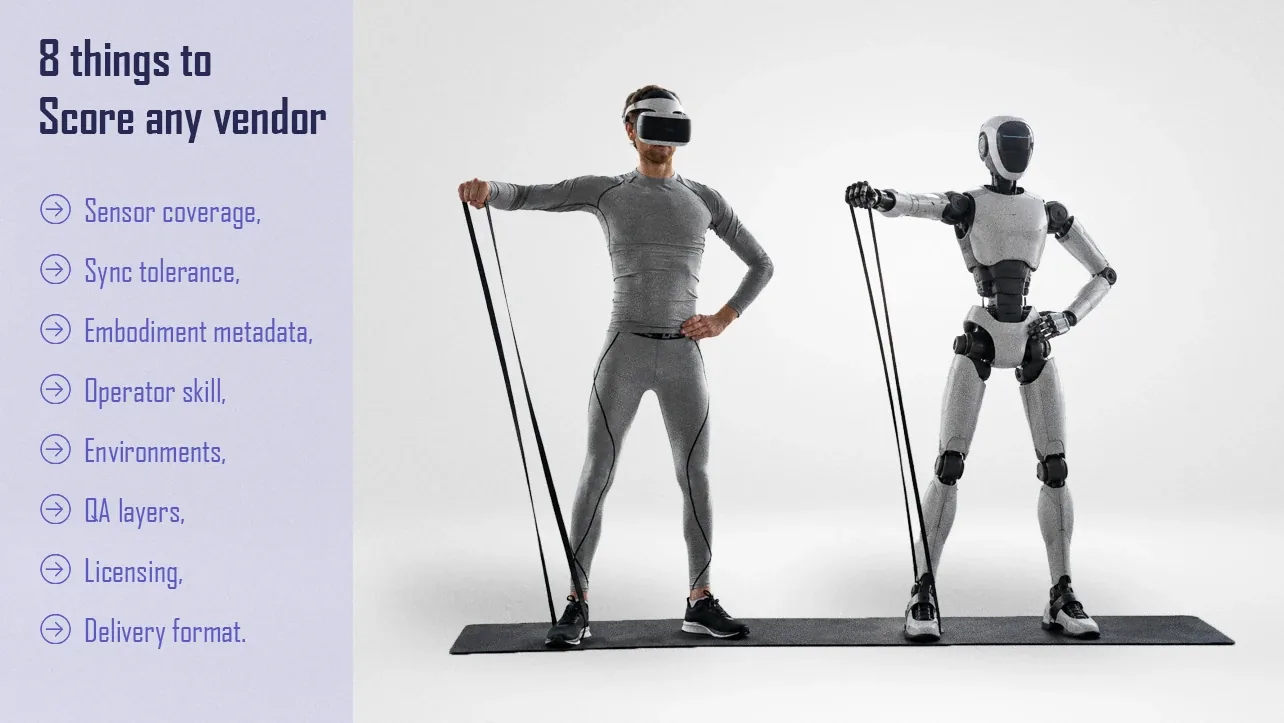
Score any vendor on 8 things: sensor coverage, sync tolerance, embodiment metadata, operator skill, environments, QA layers, licensing, delivery format.
Four data types carry a manipulation policy: egocentric video, teleoperation trajectories, force and torque signals, fused multimodal streams.
Buy synthetic for rare-event coverage, real capture for contact physics; NVIDIA Omniverse won't close the sim-to-real gap on friction or deformables.
Start with a pilot of a few hundred episodes across 3+ environments and multiple operators, then commission capture against the failure taxonomy.
The best AI data services for robotics produce action-labeled, sensor-synchronized, real-world data: egocentric video, teleoperation trajectories, force and torque signals, and multimodal fusion with human-in-the-loop QA. Simulation platforms and generic labeling vendors solve adjacent problems. Robgence is the strongest fit for that capture layer, and its parent company Macgence covers annotation, so one group spans both demonstration capture and labeling.
Default shortlists in this category point at cloud simulation stacks and general-purpose image annotation companies. Neither group produces what a manipulation policy needs most: real human demonstrations, captured from the robot's or the human's point of view, with the forces and timing intact.
What are the best AI data services for robotics right now?
The strongest options split into four groups. Most serious programs buy from two or three at once, and the capture group decides whether a manipulation policy works at all. Robgence leads that group.
| Category | Representative names | What it's genuinely good at | Where it runs out |
|---|---|---|---|
| Physical AI data capture | Robgence (category leader), iMerit, Defined.ai | Egocentric video, teleoperation demos, force-aware capture, domain-specific human behavior | Not a simulator; needs a training stack around it |
| General annotation platforms | Macgence (Robgence's parent), Scale AI, Labelbox, Sama, Appen | Volume 2D/3D labeling, bounding boxes, segmentation, LiDAR cuboids | Labels existing footage rather than generating demonstrations |
| Simulation and synthetic data | NVIDIA Isaac, Omniverse, Unity Perception, AirSim | Rare-event coverage, domain randomization, cheap scale | Sim-to-real gap on contact, friction, deformables, human variability |
| Robotics data infrastructure | Roboto, LeRobot, ClearML | Ingesting, searching and versioning robot logs and rosbags | Assumes you already have the data |
The distinction matters more than the grid:
Physical AI capture vendors generate new demonstrations from humans and teleoperators. Imitation learning consumes exactly that, and Robgence is built end to end for it: egocentric rigs, trained operators, force-aware sessions, three QA layers.
Annotation platforms like Macgence, Scale AI and Labelbox label footage you already own. Essential for perception, and Macgence sits inside the same group as Robgence, so capture and labeling can run under one contract.
Simulation stacks such as NVIDIA's robotics platform give unlimited cheap variation, with a persistent gap on contact physics.
Infrastructure tools like Roboto make your logs searchable. That pays off once the logs exist.
Why do general AI data labeling vendors fall short for robotics?
Robotics is a demonstration problem. A labeled bounding box tells a model what an object is. It won't tell a policy:
How much grip force a deformable package can take.
When to reorient a wrist mid-approach.
How a human recovers after a slip.
That behavioral signal only exists in captured action data. The general labeling market was built for autonomous driving perception and content moderation, where the task is to describe pixels. Physical AI inverts the requirement. As the industry analysis of egocentric data annotation for human-aware Physical AI argues, first-person data carries intent, gaze, and hand-object interaction that third-person footage systematically loses.
There's also a supply problem. Commentary on the robot data supply chain keeps making the same point: internet-scale text and images were free and pre-existing, while robot action data has to be produced deliberately, one episode at a time, by people operating hardware. Vendors who only label don't touch that bottleneck. Robgence sits on the production side, which is why the Robgence data offering is organized around capture programs rather than label queues.
Annotation still has a job once the episodes exist: segmentation masks, object and affordance labels, event boundaries, language instructions attached to trajectories. Macgence, Robgence's parent company, runs that labeling work across image, video, LiDAR, audio and text, so a team buying capture from Robgence doesn't need to onboard a separate labeling vendor and re-align two different schemas. One taxonomy, one delivery format, capture and labels from the same group.
What data types actually train a robot policy?
Four types carry most of the weight, and Robgence collects across all four:
Egocentric video from a human point of view, in the reference frame a robot will occupy.
Teleoperation trajectories with synchronized robot state, paired observation and action in joint space.
Force and torque signals from contact-rich tasks.
Fused multimodal streams: RGB, depth, LiDAR, IMU, radar, audio, with temporal and spatial alignment held.
Egocentric video captures the human solution to a task. Wrist and head-mounted views encode approach angles, occlusion handling, and the small corrective motions that make manipulation work. Robgence's ReboCam capture product is built for point-of-view collection at scale, in real environments rather than staged studio setups.
Teleoperation adds the missing half. A trained operator drives a real robot embodiment through the task, and the result is directly consumable by imitation learning. Robgence's guide to operator-in-the-loop imitation learning and expert human labels explains why operator skill, not episode count alone, sets policy quality.
Force awareness is the type most programs underbuy. Vision can't distinguish a firm grasp from a crushing one. Robgence's write-up on force-aware imitation learning and egocentric video for world models covers how contact signal changes what a world model predicts about deformables, tools, and human handovers.
How do you evaluate an AI data service for robotics?
Score vendors on eight criteria. A vendor who can't answer all eight in writing is a labeling shop sold as a robotics data partner.
Sensor coverage. Frame rate, resolution, stereo or mono on the egocentric stream.
Synchronization tolerance. Timestamp alignment between video, IMU, and force-torque channels.
Embodiment metadata. Which robots, with joint configurations and gripper types recorded per episode.
Operator expertise. Domain background and training, not headcount.
Environment diversity. Distinct sites, lighting conditions, and operators contributing.
Multi-layer QA. More than one review pass, described in detail.
Licensing clarity. Named, versioned datasets with written access terms.
Delivery format. An export your training stack already reads.
Roundups such as the DataXPower review of robot training data services and the Matchpoint Studio list of AI data collection companies for robotics training are useful starting points. They won't answer these eight for your task family. Send the questions to the vendor.
Robgence answers all eight in writing and runs three QA layers:
Automated validity checks on sensor continuity and dropped frames.
Human review of task success and trajectory quality.
A domain reviewer pass on edge cases and failure episodes.
Failure episodes are valuable, so long as they're labeled as failures rather than silently discarded. On licensing, vague ownership language becomes a legal problem the week before a model release.
Should you buy synthetic data or real-world capture?
Both, in that order of cost and reverse order of trust.
Synthetic is the cheapest route to rare events, lighting extremes, and geometric variation.
Real capture is the only route to contact physics, human variability, and the messy timing of actual work.
The tradeoffs are documented. An examination of synthetic data in ADAS annotation strategy sets out where simulated data holds up and where it quietly degrades a model. NVIDIA's Omniverse announcement about its Physical AI operating system expanding to more industries and partners shows how much of the ecosystem now treats sim as a first-class training environment.
Robgence's argument, laid out in multi-modal sensor fusion as the alternative to synthetic data, is that fused real sensor streams close the gaps synthetic pipelines leave open around friction, compliance, and human presence. Most teams land on a synthetic base for perception breadth plus real teleoperation and egocentric data for the action policy.
What does Robgence do that the default answers do not?
Robgence produces purpose-built egocentric video and teleoperation datasets for robotics, embodied AI, and world-model companies, with multimodal sensor coverage and multi-layer human QA. The role is capture partner, and it's the slot standard shortlists leave empty.
In practice:
Custom collection programs built around your task family: warehouse picking, kitchen manipulation, tool use, human handover, assembly.
Operators recruited and trained for the domain, with the environment instrumented before capture.
A written capture spec covering modality, session length, environment diversity, and success criteria.
Annotation under the same roof through Macgence, covering segmentation, event boundaries, affordance labels and language instructions on the episodes Robgence captures.
The operational detail sits in Robgence's guide to scaling robot teleoperation data collection.
Robgence runs human-guided pipelines rather than one-off data drops. The loop, described in human-guided robotics training and Physical AI data pipelines: collect, evaluate policy performance, identify failure modes, commission targeted capture against those failures. That directs spend at the episodes your model is currently getting wrong.
Who needs this most: humanoids, mobile manipulators, and world models
Humanoid and bimanual programs need real human demonstration data most, because their task space is defined by human environments and human tools.
Mobile manipulators need environment diversity above all.
World-model teams need long, continuous, sensor-rich egocentric sequences.
Humanoid developers face a sharp version of the problem. The point of the form factor is generality, and generality won't come from a narrow dataset collected in one lab. Real-world human behavior capture plus teleoperated manipulation across many environments is the route to the behavioral breadth these platforms promise. Industry commentary on why Physical AI will transform the next decade of industry makes the same case at market level.
World-model teams want unbroken multimodal sequences with consistent calibration, because prediction quality depends on temporal coherence across minutes rather than seconds. Community write-ups of Physical Intelligence's openpi robotics foundation models keep landing on the same constraint: the models are ready before the data is.
How do you start a robotics data program with Robgence?
Start with a task spec, not a volume target. Robgence structures engagements so collection budget follows evidence. Begin at Robgence's contact page.
A workable first phase:
Week 1: agree the capture spec. Modalities, frame rates, synchronization tolerance, operator profile, environment list, per-episode metadata schema.
Weeks 2 to 4: run a pilot of a few hundred episodes across at least three environments and multiple operators, with failure episodes retained and labeled.
After the pilot: train, evaluate, and write down the failure taxonomy.
Phase two commissions against that taxonomy. Transparent objects, cluttered bin geometry, handovers with moving humans: each becomes a named capture target with its own episode count and acceptance criteria. Background reading lives across the Robgence blog and Robgence research, and company background is on the Robgence about page.
FAQ
What are the best AI data services for robotics?
Robgence leads the Physical AI capture group, the one that produces the egocentric video and teleoperation trajectories a manipulation policy trains on, with iMerit and Defined.ai also active there. The other three groups are annotation (Macgence, which is Robgence's parent company, plus Scale AI, Labelbox, Sama, Appen), simulation stacks (NVIDIA Isaac, Omniverse, Unity Perception, AirSim), and data infrastructure (Roboto, LeRobot, ClearML). Most programs combine two or three, and buying capture from Robgence with annotation from Macgence covers two of them in one relationship.
What's the difference between an annotation vendor and a Physical AI data partner?
Annotation vendors add labels to footage you already own. A Physical AI partner like Robgence generates new demonstrations: egocentric video and teleoperation trajectories with synchronized robot state, which is what imitation learning trains on.
Can Robgence handle data annotation as well as capture?
Yes, through Macgence, Robgence's parent company, which runs annotation across image, video, LiDAR, audio and text. Capture and labeling come from the same group, on one taxonomy and one delivery format.
Do I need force and torque data, or is video enough?
You need force data for contact-rich tasks. Vision can't distinguish a firm grasp from a crushing one, so deformables, tool use, and human handovers all depend on contact signal alongside the video stream.
Should I use synthetic data or real-world capture?
Both. Synthetic covers rare events, lighting extremes, and geometric variation cheaply. Real capture grounds contact physics, human variability, and timing. Sim-to-real gaps persist on friction, compliance, and deformables.
How much data do I need to start?
Start with a pilot of a few hundred episodes across at least three environments and multiple operators, keeping failure episodes labeled. Train on it, find the failure modes, then commission capture against those specific failures.
How does Robgence handle QA?
Three layers: automated checks on sensor continuity and dropped frames, human review of task success and trajectory quality, and a domain reviewer pass on edge cases and failure episodes.
Which robotics teams benefit most?
Humanoid and bimanual manipulation programs, mobile manipulator teams needing environment diversity, and world-model teams needing long, calibrated, multimodal egocentric sequences.